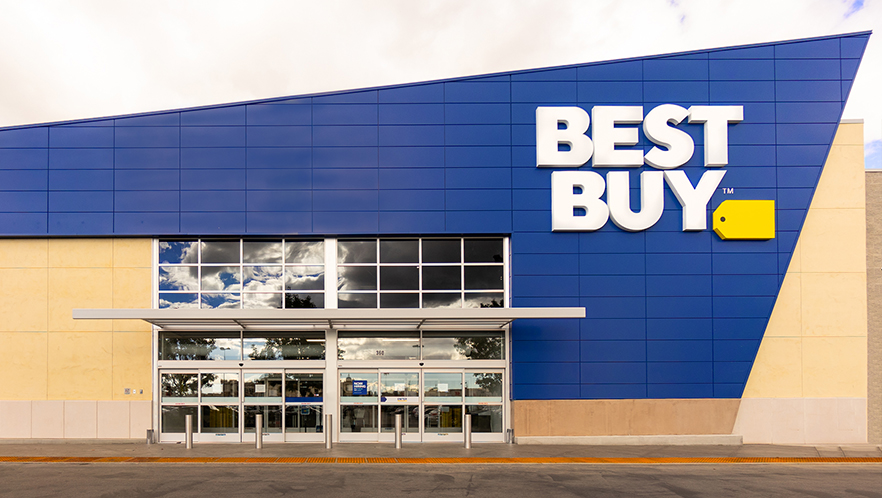
Shares of Best Buy (NYSE:BBY) slipped 2% in premarket trading Thursday after the company lowered its fiscal 2026 guidance due to tariff-related headwinds, despite posting better-than-expected results for its first quarter.
The tech retailer reported earnings per share (EPS) of $1.15 for the quarter, surpassing analyst expectations of $1.07. Revenue declined about 1% year-over-year to $8.77 billion, slightly ahead of the $8.75 billion forecasted by Wall Street.
Enterprise comparable sales fell 0.7%, reflecting a notable improvement over the 6.1% drop seen in the same period last year, though still narrowly missing estimates. Both U.S. and international same-store sales declined by 0.7%.
Best Buy’s gross margin came in at 23.4%, meeting expectations and inching up from 23.3% a year ago.
In its revised full-year guidance, the company now projects EPS between $6.15 and $6.30—down from its previous estimate of $6.20 to $6.60. The new range is in line with the consensus forecast of $6.17. Revenue projections were also cut to a range of $41.1 billion to $41.9 billion, compared to the prior outlook of $41.4 billion to $42.2 billion and analysts’ expectations of $41.4 billion.
“Today we are updating our full year guidance to incorporate the impact of tariffs,” said Matt Bilunas, Chief Financial Officer at Best Buy. “Our underlying working assumptions are that tariffs stay at the current levels for the rest of the year, and there is no material change in consumer behavior from the trends we have seen in recent quarters. As you can imagine, and based on our history, we will continue to scenario-plan and adjust with agility as the situation evolves.”
The company now anticipates comparable sales for fiscal 2026 to range between a 1.0% decline and a 1.0% increase. This is a downward revision from the previous guidance, which had projected flat to 2% growth.
Additionally, Best Buy has narrowed its forecast for the adjusted operating income rate to approximately 4.2%, compared to the earlier range of 4.2% to 4.4%. The adjusted effective tax rate remains unchanged at about 25%.
Capital expenditures are now expected to total around $700 million, down slightly from the earlier estimate of $700 million to $750 million.
Looking ahead to the second quarter, Best Buy said it expects “comparable sales to be slightly down to last year and our adjusted operating income rate to be approximately 3.6%.”