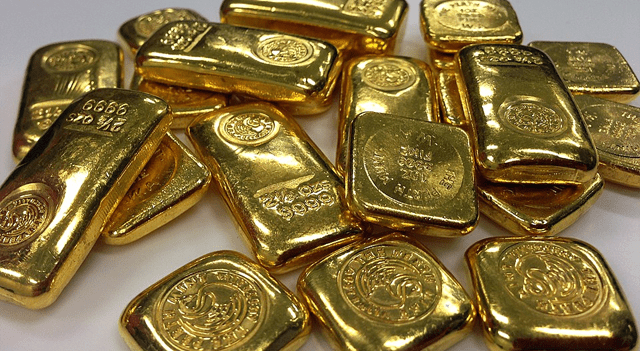
Gold prices surged to new all-time highs on Wednesday, climbing beyond $5,200 an ounce as investors sought safety amid geopolitical tensions, policy uncertainty and a sharply weaker U.S. dollar.
Spot gold briefly touched a record $5,266.38 per ounce, while April gold futures peaked at $5,297.86 per ounce. The rally was mirrored across precious metals, with silver and platinum holding close to their own recent highs. Demand for havens was reinforced by investor caution ahead of the conclusion of the Federal Reserve’s policy meeting later in the day.
Geopolitics and policy risks fuel gold rally
Safe-haven appetite strengthened after U.S. President Donald Trump said a second naval armada was heading toward Iran, adding that he hoped Tehran would agree to a deal with Washington. Broader uncertainty around U.S. foreign and domestic policy has been a key driver of gold’s strong performance this year, following renewed tensions linked to developments in Venezuela and a diplomatic dispute involving Greenland.
Gold is now up roughly 20% so far in 2026, building on an already strong advance in the previous year as investors increasingly turned to defensive assets.
A weaker dollar has also played a major role. The greenback slid to a near four-year low this week, providing further support for bullion and the wider metals complex. Trump said on Tuesday that he was unconcerned by the dollar’s decline, comments that triggered additional selling pressure on the currency.
Silver and platinum stay firm ahead of Fed decision
Other precious metals remained buoyant, supported by risk aversion and the softer dollar. Spot silver jumped 2.8% to $115.2455 per ounce, while spot platinum rose 1.3% to $2,688.23 per ounce.
Analysts at ANZ noted that silver has been a key beneficiary of physical demand in China, where investors have relatively limited options for metals exposure and tend to favour purchases of physical bars and coins.
The gains across metals come as the Federal Reserve prepares to wrap up its two-day meeting, with policymakers widely expected to leave interest rates unchanged at 3.75%. Market focus is now squarely on Fed Chair Jerome Powell’s commentary and whether he addresses recent pressure from Washington to deliver aggressive rate cuts.
Trump said on Tuesday that he was close to naming his choice to succeed Powell as Fed chair and suggested that interest rates would fall under new leadership. This follows comments from Powell earlier in January, when he said Washington was attempting to pressure the Fed into cutting rates via a Department of Justice investigation—remarks that intensified concerns about the central bank’s independence.