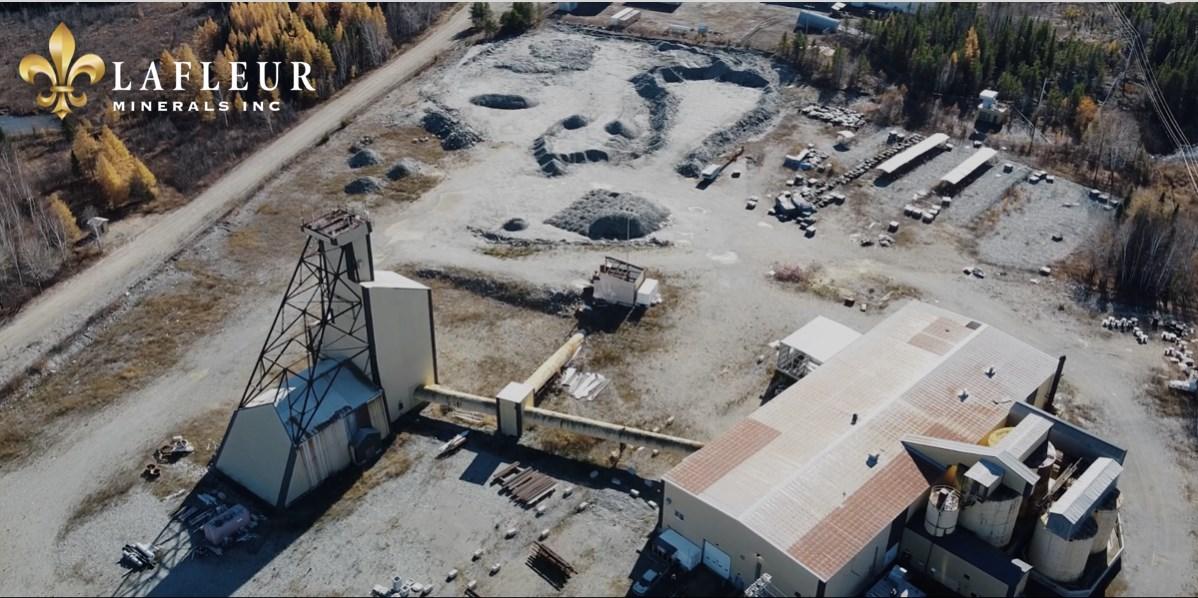
LaFleur Minerals is moving quickly from planning to execution as it advances a fully integrated gold production strategy in Québec’s prolific Abitibi Gold Belt. With technical studies nearing completion and recommissioning work underway at its wholly owned Beacon Gold Mill, the company is positioning itself to restart gold production at a time when gold prices are at historic highs.
This article has been disseminated on behalf of LaFleur Minerals Inc. and may include a paid advertisement.
At the center of this strategy is LaFleur’s 100%-owned Swanson Gold Deposit, located just 50 kilometres from the Beacon mill near Val-d’Or. Together, the mine-to-mill pairing forms a vertically integrated platform that gives LaFleur rare control over costs, margins, and production timing. The company’s upcoming Preliminary Economic Assessment (PEA), now in its final stages, will outline how Swanson ore will feed Beacon in the near and long term.
The Beacon Gold Mill last operated in 2022, when gold traded around US$1,800–$2,000 per ounce. Today, with prices exceeding US$4,800/oz, LaFleur is laser focused on restarting the facility and scaling its throughput. The mill is currently permitted and refurbished to handle 750 tonnes per day, with the PEA base case targeting 1,000 tpd and longer-term expansion scenarios reaching 3,000–4,000 tpd.
Swanson is already supported by a NI 43-101 compliant mineral resource. The deposit hosts over 123,000 ounces of indicated gold and an additional 64,500 ounces inferred, with both open pit and underground potential. Recent verification drilling has been completed to support the PEA, and metallurgical testing is underway to optimize recoveries at the Beacon mill.
LaFleur recently closed $7.8 million in financing, fully funding the Beacon restart and pushing the company into revenue-generation mode. Unlike many peers still in the conceptual stage, LaFleur owns both the mine and the mill, and is now executing.
Behind the scenes, technical and infrastructure work is advancing on several fronts. Engineering teams from Bumigeme and ERM are evaluating upgrades to the crushing, grinding, and flotation circuits to boost throughput. Discussions are also underway with Canadian National Railway to enhance rail infrastructure between Swanson and Beacon, potentially lowering transport costs, reducing emissions, and positioning the mill as a regional processing hub.
Operational progress at the Beacon site has been steady. Since late 2025, contractors have been mobilized, site services restored, and critical inspections completed. Electrical and heating upgrades are finished, equipment modernization is underway, and recommissioning of the crushing circuit and overhead cranes is scheduled to begin by the end of January 2026. The goal is to process an initial 100,000-tonne bulk sample from Swanson as part of the ramp-up strategy.
Looking beyond the PEA, LaFleur is already studying mill expansion scenarios and longer-term mine development options. With power, permits, and tailings capacity in place, Beacon offers a rare opportunity to build a scalable, modern gold processing operation in the heart of the Abitibi.
Paul Ténière, CEO of LaFleur Minerals commented, “LaFleur Minerals is pleased with the technical milestones achieved to date, which represent strong progress as we advance toward delivery of a fully integrated PEA for our 100%-owned Swanson Gold Deposit and nearby Beacon Gold Mill. This work positions the Company to continue to fast track its streamlined development strategy centred on a restart of gold production at the Beacon Gold Mill located within one of Canada’s most established and well-supported Abitibi Gold Belt and ValDor, Quebec, gold-mining districts.”
As LaFleur transitions from developer to producer, the company is not just betting on gold prices it’s building the infrastructure to capture their full upside.