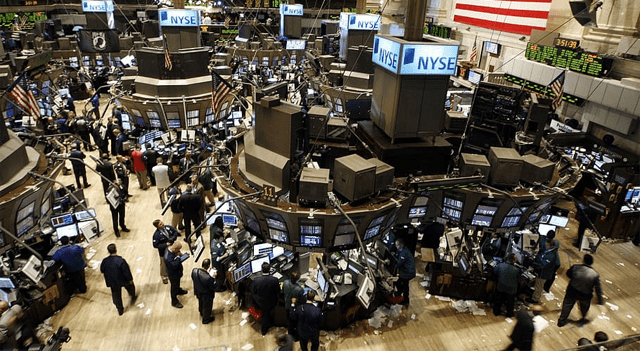
U.S. equity futures are pointing decisively lower, even after Wall Street managed to recover on Monday in the wake of renewed hostilities involving Iran. President Donald Trump signaled that the joint U.S.-Israeli campaign could extend for weeks, stating Washington will do “whatever it takes.” Meanwhile, oil prices are climbing on fears of supply disruptions through the strategically vital Strait of Hormuz, while spot gold has eased as the U.S. dollar strengthens. Investors are also awaiting fresh quarterly results from Target (NYSE:TGT).
Futures point to a weak open
U.S. stock index futures tumbled early Tuesday, indicating a negative start after equities steadied in the previous session despite ongoing geopolitical tensions.
As of 03:03 ET, Dow futures were down 540 points, or 1.1%. S&P 500 futures had fallen 76 points, also 1.1%, while Nasdaq 100 futures dropped 347 points, or 1.4%.
On Monday, both the S&P 500 and the tech-heavy Nasdaq Composite closed higher, rebounding from steep early losses triggered by weekend strikes on Iran by the U.S. and Israel that reportedly killed Tehran’s longtime leader Ayatollah Ali Khamenei. The Dow Jones Industrial Average ended just 0.2% lower, having recovered much of its earlier decline.
“[S]tocks saw pressure out of the gate, but the major indices staged an impressive rebound from their lows as U.S. equity investors stayed calm about events unfolding in the Middle East,” analysts at Vital Knowledge wrote in a client note.
They added that although Trump suggested the campaign could continue for four to five weeks and Iran responded with air strikes across the region, the “consensus view is that this conflict won’t metastasize into an uncontrolled quagmire.”
Beyond Iran, markets were also digesting a rebound in previously out-of-favor technology stocks and data showing a sharp rise in input costs for U.S. manufacturers.
Focus remains on Iran
The trajectory of the conflict remains uncertain, with Trump acknowledging that the situation could extend beyond initial expectations.
At his first public appearance since the attacks began, Trump said “we’re already substantially ahead of our time projections,” but emphasized that “whatever the time is, it’s okay.”
“Whatever it takes,” Trump said, later adding in a social media post that the U.S. possesses a “virtually unlimited” stockpile of certain weapons.
Reuters reported that the joint U.S.-Israeli offensive has resulted in the sinking of at least 10 Iranian naval vessels and targeted more than 1,000 sites. Israeli forces have indicated they are continuing strikes in Iran and Lebanon, while also expanding operations in southern Lebanon.
Iran has intensified its response, according to media reports, launching strikes early Tuesday against locations in the Gulf, including the U.S. embassy in Saudi Arabia and Dubai’s airport, a key international transit hub. Airline and hotel stocks were among Monday’s biggest decliners, reflecting fears of flight disruptions.
Amazon’s cloud division disclosed that two of its facilities in the UAE and Bahrain were struck by drones and were “significantly impaired.”
Oil extends rally
Crude prices continued their upward march Tuesday, building on substantial gains from the previous session as concerns mounted over potential interruptions to shipping through the Strait of Hormuz.
Brent crude futures surged 4.3% to $81.10 per barrel, while U.S. West Texas Intermediate advanced 4% to $74.05 per barrel.
Both benchmarks had already jumped more than 7% on Monday after rising as much as 13% to one-year highs.
The escalation intensified after Iranian officials threatened to attack any vessel attempting to transit the Strait of Hormuz, a critical chokepoint through which roughly 20% of global oil supply flows.
“While a full, long-term closure of the Strait remains an extreme scenario, even partial disruption to tanker traffic tightens market balances and could push crude prices materially higher if sustained. Continued military escalation and elevated risk premia in energy markets are likely to dominate price action until there is clearer evidence of de-escalation or alternative supply routes emerge,” Laurence Booth, Global Head of Markets at CMC Markets, told Investing.com.
Some analysts have noted that OPEC+ producers may increase output, potentially cushioning the impact of major supply interruptions.
Energy supply concerns weighed heavily on Asian equities Tuesday, with markets in South Korea, Tokyo and Taiwan posting losses. European shares also moved lower.
Gold slips as dollar strengthens
Spot gold edged lower after early gains, pressured by a stronger U.S. dollar even as investors weighed escalating tensions and oil supply risks.
Spot gold was last down 0.3% at $5,309.17 per ounce, after earlier climbing as much as 1% to $5,379.65. U.S. gold futures rose 0.2% to $5,320.24 per ounce. The metal had advanced 1% in the prior session.
Gold typically benefits from geopolitical uncertainty but can lose appeal when the dollar appreciates.
Target earnings ahead
Target is scheduled to release its latest quarterly results, offering further insight into U.S. consumer behavior amid ongoing affordability pressures.
While Trump has described the economy as “roaring,” surveys suggest many Americans are less optimistic. A Reuters/Ipsos poll last month found that 68% of respondents, including Republicans, disagreed with that characterization.
U.S. economic growth slowed more than expected in the fourth quarter, though analysts largely attributed the slowdown to a temporary government shutdown, pointing to resilient consumer and business spending. Some economists forecast moderate expansion in 2026, aided in part by tax cuts enacted in Trump’s budget legislation last year.
Against this backdrop, Target has struggled to attract cost-conscious shoppers, in contrast to competitors such as Walmart. The retailer’s profit has declined 14% over the past five years.
Major shareholders, including pension funds in New York and California, have since begun publicly challenging management decisions.