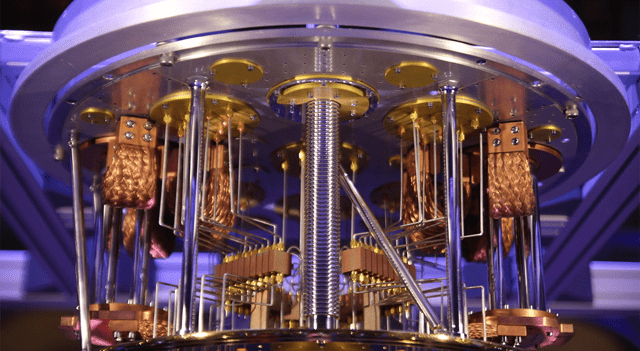
IBM (NYSE:IBM) said its quantum computer has successfully simulated the behavior of real magnetic materials, producing results that align with neutron scattering experiments carried out at U.S. national laboratories. The research was conducted by scientists from the Department of Energy-funded Quantum Science Center at Oak Ridge National Laboratory together with researchers from Purdue University, the University of Illinois Urbana-Champaign, Los Alamos National Laboratory, the University of Tennessee and IBM.
The study focused on the magnetic crystal KCuF₃, with researchers directly comparing neutron scattering observations with simulations generated by a quantum processor. The findings showed strong agreement between the experimental measurements and the quantum computer’s ability to capture the dynamic properties of the material.
“This is the most impressive match I’ve seen between experimental data and qubit simulation, and it definitely raises the bar for what can be expected from quantum computers,” said Allen Scheie, a condensed matter physicist at Los Alamos National Laboratory.
The research relied on quantum-centric supercomputing methods that integrate quantum processors with classical computing resources. IBM principal research scientist Abhinav Kandala said the results were made possible in part by improvements in two-qubit error rates on the company’s quantum hardware.
Scientists have traditionally relied on neutron sources to investigate quantum characteristics of materials by analyzing how neutrons exchange energy and momentum with atomic spins. Using quantum computers for these simulations may help overcome limitations faced by classical computational methods when modeling complex quantum interactions.
Researchers have already expanded the technique beyond KCuF₃ to explore materials with more complicated interaction patterns. The work has been released as a preprint and forms part of a broader push to apply quantum computing to scientific research, following earlier IBM simulations that included a half-Möbius molecule and protein modeling carried out with the Cleveland Clinic.