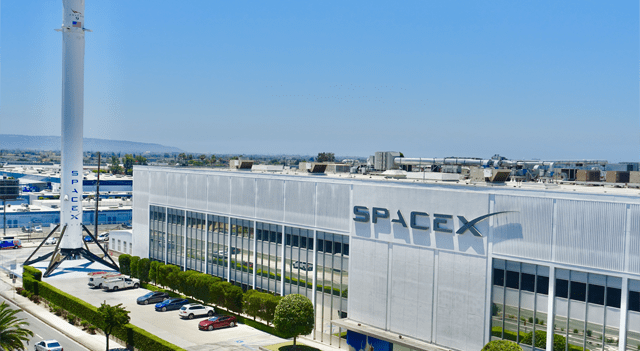
SpaceX has publicly released its IPO filing, offering investors a detailed look at the scale of Elon Musk’s artificial intelligence ambitions, the financial losses tied to those investments and the company’s reliance on technologies and markets that are still largely undeveloped.
The filing outlines a strategy heavily focused on future opportunities ranging from Mars colonisation to space-based AI data centres, as the company seeks to evolve beyond its core rocket and satellite operations into a broader AI and infrastructure powerhouse.
AI expansion drives losses despite Starlink profitability
The filing showed that of SpaceX’s three business divisions, only the connectivity segment led by Starlink generated a profit during the first quarter of the year.
Starlink recorded an operating profit of $1.19 billion, but the wider company still reported a total operating loss of $1.94 billion on revenue of $4.69 billion. SpaceX’s artificial intelligence division alone generated losses of $2.47 billion while producing $818 million in revenue.
The February acquisition of xAI significantly increased the company’s spending commitments, accounting for 76% of SpaceX’s $10.1 billion in capital expenditure during the quarter. The filing stated that the deal provided the company with expanded AI capabilities and strategic opportunities, but also introduced substantial costs and fresh losses.
Much of the company’s projected future growth depends on technologies that remain under development, including plans for solar-powered data centres in space. According to the filing, SpaceX estimates these emerging markets could eventually represent a $28.5 trillion opportunity.
Musk retains overwhelming control of SpaceX
The prospectus reinforced Elon Musk’s dominant position within the company, showing he will continue to control 85.1% of combined voting power after the listing.
SpaceX plans to adopt a dual-class share structure, with Class B shares carrying 10 votes each while Class A shares sold to public investors will carry a single vote. The filing also details governance provisions that significantly limit shareholder influence, including restrictions on legal claims and protections preventing Musk’s removal except by his own authority.
The company’s board has also linked a substantial portion of Musk’s compensation to ambitious long-term goals, including establishing a permanent human settlement on Mars and developing massive space-based computing infrastructure powered by the equivalent of 100 terawatts of energy capacity.
Potential record-breaking IPO targets valuation of $1.75 trillion
SpaceX said it aims to begin its public market debut as early as June 12, with a roadshow expected to launch on June 4 and the share sale potentially taking place on June 11.
A successful listing could value the company at approximately $1.75 trillion, surpassing the valuation achieved by Saudi Aramco during its record 2019 IPO and potentially making SpaceX the first U.S.-listed company to debut above the $1 trillion threshold.
Analysts noted that traditional valuation comparisons remain difficult because of the unique nature of SpaceX’s business model and Musk’s influence.
“There is somewhat of a halo effect around Musk and his unconventional vision,” said Reena Aggarwal, a finance professor at Georgetown University. “It is difficult to value companies like this because there is no peer group for comparison.”
Starlink growth and AI infrastructure partnerships support expansion plans
SpaceX has grown into the world’s largest space company since its founding in 2002, largely through the rapid expansion of its Starlink satellite internet network and its reusable rocket technology.
The company currently operates roughly 10,000 satellites and continues to expand across consumer broadband, aviation, maritime, enterprise and government markets.
The filing also revealed major commercial AI infrastructure agreements, including a deal under which Anthropic will pay SpaceX $1.25 billion per month through May 2029 to access computing capacity at its Colossus and Colossus II data centre facilities in Memphis, Tennessee.
SpaceX disclosed that it is currently facing multiple lawsuits linked to image-generation and editing functions within its Grok AI chatbot platform.
Space race intensifies as listing approaches
The IPO filing arrives during a pivotal period for the company as it prepares for another test launch of its next-generation Starship rocket.
Competition within the commercial space sector continues to intensify, with rivals including Blue Origin seeking to challenge SpaceX in satellite deployment, launch services and government contracts.
The company is expected to list on Nasdaq and Nasdaq Texas under the ticker symbol “SPCX,” with Goldman Sachs, Morgan Stanley, Bank of America, Citigroup and J.P. Morgan serving as lead underwriters.