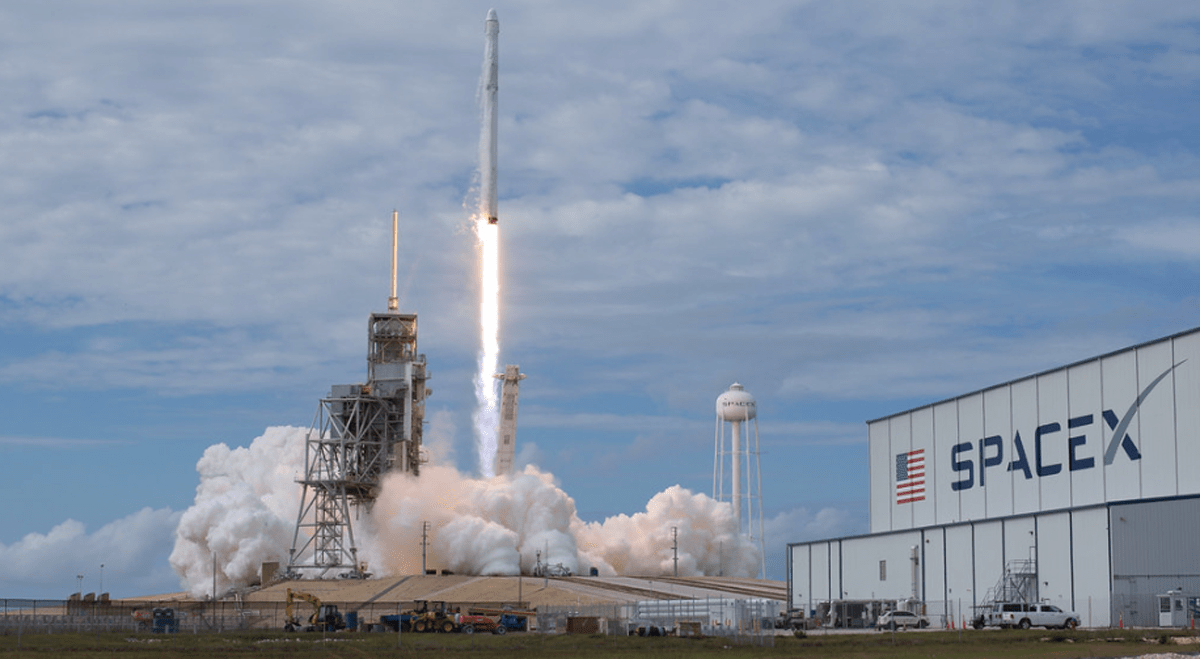
SpaceX (NASDAQ:SPCX) is preparing to begin trading on Nasdaq on Friday after completing the largest initial public offering ever, with investors committing $75 billion in a vote of confidence that Elon Musk’s long-term ambitions in space exploration, communications and artificial intelligence can support a valuation of $1.77 trillion.
The landmark flotation has cemented Musk’s position as the world’s first trillionaire and elevated SpaceX into the ranks of the most valuable companies globally, despite the business reporting a loss of almost $5 billion last year and generating only a small fraction of the revenue produced by other companies with comparable valuations.
Market Debut Will Test the “Musk Premium”
The company’s first day of trading is expected to serve as a major test of the so-called “Musk premium,” the investor enthusiasm that has helped propel Tesla to a valuation exceeding $1 trillion.
The debut will also be closely monitored by investors looking for clues about market appetite ahead of potential stock market listings by artificial intelligence leaders Anthropic and OpenAI.
Many market participants see SpaceX’s flotation as a blueprint for a new era of mega-sized IPOs, placing additional pressure on exchanges and underwriters to ensure the process runs smoothly and avoids the technical problems that disrupted Meta’s market debut in 2012.
Trading is not expected to begin immediately after the market opens, as Nasdaq gathers buy and sell orders and underwriters work to establish a balanced opening price. SpaceX priced its shares at $135 and sold 555.56 million shares as part of the offering.
Record-Breaking Listing Rewrites IPO History
The transaction represents the culmination of Musk’s long-standing vision for SpaceX and stands out as one of the most significant events in the history of public markets.
The $75 billion raised through the offering more than doubled the amount generated by Saudi Aramco’s record-setting 2019 IPO, making SpaceX the largest public listing ever completed.
The offering also created the first trillion-dollar market debut in U.S. history and immediately positioned SpaceX as the seventh-largest publicly traded company in the United States by market capitalisation.
The company’s valuation could climb even higher if underwriters choose to exercise their option to sell additional shares, a decision that is typically made within 30 days of an IPO.
Nasdaq 100 Inclusion Could Drive Further Demand
Although SpaceX may need to wait before becoming eligible for inclusion in the S&P 500, investors expect the company to join the Nasdaq 100 relatively quickly.
Under Nasdaq’s accelerated inclusion rules, SpaceX could be added to the index in roughly a month, rather than waiting up to a year under traditional procedures.
Such a move would make the company a significant holding for exchange-traded funds and passive investment products that track the Nasdaq 100, creating another potential source of demand for the shares.
Some analysts believe the stock’s arrival could trigger portfolio adjustments across the technology sector as institutional investors reallocate capital toward SpaceX.
Retail Investor Demand Creates Both Opportunity and Risk
The extraordinary level of interest surrounding the IPO presents both opportunities and risks for investors, according to market observers.
Jay Woods, chief market strategist at Freedom Capital Markets, said retail investors who were unable to participate in the offering may rush to buy shares once trading begins.
SpaceX allocated 30% of the IPO to retail investors, seeking to capitalise on Musk’s popularity among individual traders who have previously helped fuel major gains in Tesla shares.
“Historically, those investors tend to be the most vulnerable if momentum reverses,” Woods said. “I think there will be better opportunities to enter this name down the road.”
Investors Focus on Massive Long-Term Market Potential
Despite the excitement surrounding the listing, valuing SpaceX remains a challenge for analysts and investors.
The company estimates that its addressable market is worth $28.5 trillion, describing it as the largest commercial opportunity in history.
Supporters point to SpaceX’s dominant position in the space industry, noting that the company claims responsibility for more than four-fifths of all mass launched into orbit during the past three years. They also highlight the growing contribution from its Starlink satellite communications business.
John Belton, portfolio manager at Gabelli Funds, said Tesla offers the closest comparison because both businesses combine an established operating company with a potentially transformative long-term opportunity.
“For Tesla, that’s things like humanoid robotics and other future applications. For SpaceX, it’s the AI business,” he said.
Valuation Debate Continues
While many investors remain optimistic, others question whether SpaceX’s valuation can be justified.
The company faces increasing competition from rivals such as Jeff Bezos’ Blue Origin, which is accelerating efforts to commercialise space technologies and secure government contracts in pursuit of new growth opportunities beyond Earth.
Earlier this month, analysts at Morningstar suggested that SpaceX’s fair value may be closer to $780 billion, less than half of its expected market capitalisation at the start of trading.
Nonetheless, some investors argue that traditional valuation metrics may not fully capture the company’s future potential.
“This is not a name you’re buying based on fundamentals. For me, the analogy is Amazon. This was a company that changed the way we live,” said Nancy Tengler, CEO and CIO of Laffer Tengler Investments. “If the IPO comes out at $135 and the stock drops to $100, that’s not ideal, but it wouldn’t change our long-term view. We want to participate.”
Want to stay up-to-date on the SpaceX IPO? Find the top asked questions from investors and follow their every move here: https://invest.investorshub.com/spacex-ipo-watch/