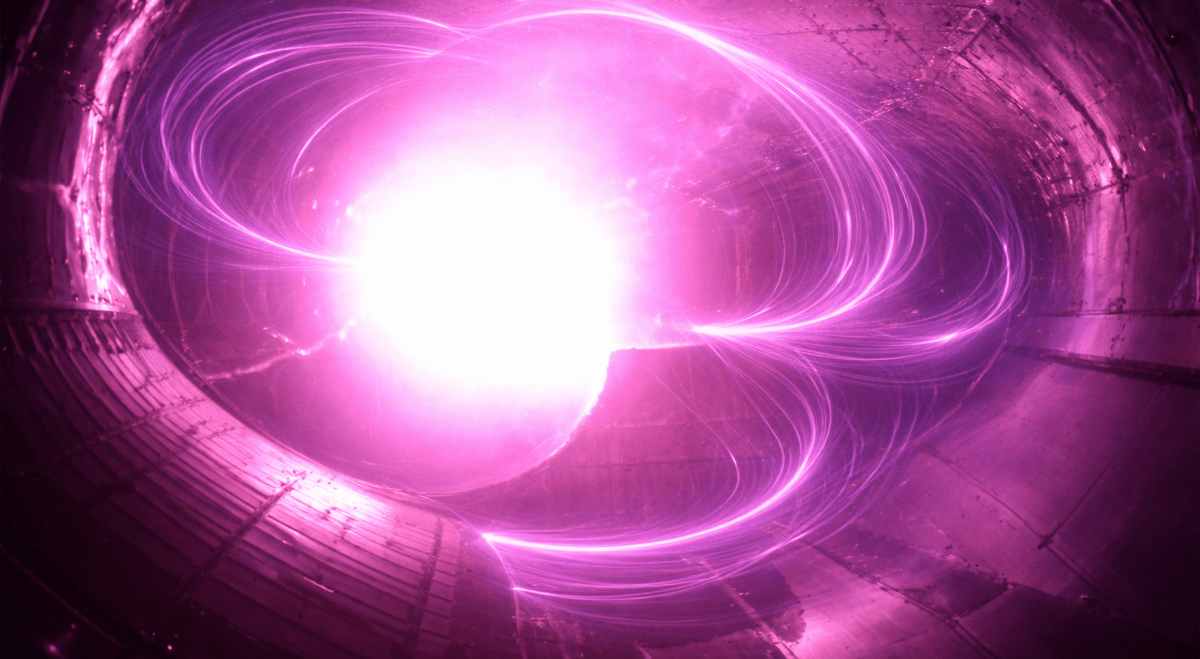
American Fusion has detailed the theoretical physics behind its Texatron Fusion Engine, outlining how pulsed magnetic compression and a rifled chamber could potentially create and confine plasma while identifying the key performance requirements that still need experimental validation.
Key Investor Takeaways
- American Fusion (USOTC:AMFN) released a technical analysis detailing the proposed Texatron plasma compression and confinement approach underlying its fusion development program.
- The Texatron design uses a capacitor-powered magnetic pulse and spiral chamber geometry intended to compress, heat and organize a toroidal plasma.
- Earlier low-temperature experiments reportedly produced plasma that remained separated from the chamber walls for periods around one second, but this does not demonstrate comparable confinement at fusion temperatures.
- The company is now focused on measuring plasma temperature, density, magnetic-field strength, compression and confinement while testing whether results can be reproduced.
- Fusion ignition, net energy gain and direct electricity generation have not been demonstrated and remain development objectives.
Why AMFN Stock Is in Focus
American Fusion has provided a more detailed technical framework for how its Texatron Fusion Engine is intended to create and confine the plasma required for fusion.
The system is designed to discharge energy stored in a capacitor bank to generate a short, powerful magnetic pulse. That pulse would compress a doughnut-shaped, or toroidal, plasma, increasing its temperature and density through compression and shock waves.
Central to the design is what Chief Technology Officer Dr. John E. Brandenburg calls the Rifled Toroidal Pinch. Spiral grooves or ridges inside the chamber are intended to influence electrical currents and create a twisted magnetic field that can be transferred to the forming plasma.
The analysis also introduces a theoretical “Double Invariant” framework involving magnetic helicity and a second flux property termed “baricity.” Brandenburg proposes that preserving these properties could help maintain plasma stability during compression.
These concepts remain theoretical at the higher energies required for fusion, and American Fusion said experimental testing is needed to establish whether the proposed magnetic structure forms and provides the intended confinement.
Why This Matters for Investors
The technical analysis provides investors with more specific criteria for assessing whether Texatron can progress from a proposed fusion architecture toward experimentally demonstrated performance.
Earlier low-temperature experiments cited by Brandenburg reportedly produced plasma that settled into a relatively quiet state, remained separated from the chamber walls and persisted for periods of approximately one second.
The limitation is important: those experiments did not demonstrate one-second plasma confinement at fusion temperatures or the production of fusion energy.
American Fusion’s current testing therefore shifts attention toward measurable results. The company is working to determine plasma temperature and density, magnetic-field strength, compression and confinement, as well as whether its chamber geometry produces the intended behavior consistently.
The proposed system ultimately targets deuterium-helium-3 fusion. American Fusion envisions using the charged particles generated by that reaction to induce electrical current through changes in magnetic flux, potentially allowing direct electricity recovery rather than first converting fusion energy into steam for a turbine.
The technical assumptions are demanding. The analysis considers ion densities around 10¹⁷ per cubic centimeter and pre-ignition temperatures of several kiloelectronvolts. American Fusion explicitly stated that these figures are theoretical design assumptions rather than measured Texatron performance or demonstrated ignition thresholds.
That distinction makes experimental validation the central issue for AMFN investors. The company has not demonstrated fusion ignition, net energy gain or direct conversion of fusion energy into electricity.
What to Watch Next
The next milestones centre on experimental measurements and repeatability. American Fusion needs to establish whether Texatron can reproducibly generate the required plasma conditions while maintaining the magnetic structures described in Brandenburg’s theoretical framework.
Investors can watch for measured temperature, density, compression and confinement data as operating conditions increase, along with evidence of whether the Rifled Toroidal Pinch performs as intended.
Beyond that, evidence of fusion reaction products, progress toward net energy gain and eventual testing of direct electrical energy recovery would represent subsequent development milestones if the earlier experimental objectives are achieved.