If a savvy investor were asked to name the industries a society needs to flourish, they might mention fossil fuels, renewable energy, defense, manufacturing and advanced technologies, such as AI, electronics and medical equipment, each carefully chosen to ensure a strong sense of national security and environmental sustainability, such that the brightest minds would be free to innovate the way towards a more compelling future.
However, these industrial pillars wouldn’t be possible without the mining of critical minerals, which are relied upon across the industrial complex for their unmatched ability to conduct electricity and resist heat and corrosion, prompting countries across the world, including Canada and the United States, to publish official lists of the minerals most strategic to their economies.
This article is disseminated in partnership with Grid Metals Corp. It is intended to inform investors and should not be taken as a recommendation or financial advice.
Now, while a certain number of critical minerals are in abundant supply and not a cause for governmental concern, such as silicon and aluminum, a great deal of others are weathering deficits at risk of generational consequences because of limited exploration, processing and production, creating asymmetric opportunities for investors to identify mining companies optimally positioned to satiate demand.
The holy trinity of rarity, high value and high demand
When it comes to critical minerals with concerning supply dynamics, cesium sits towards the top of the list, due to its widespread applications and concentrated supply chain.
In terms of applications, more than half of cesium supply is used to make cesium formate, a biodegradable drilling fluid for oil, natural gas and other large-scale drilling projects, with meaningful tonnage also serving the defense, glass, pharmaceutical, medical imaging, military-grade optics, solar panel, precision timing and radiation detection industries, illustrating the critical mineral’s diversified demand.
In terms of supply chain, there are only three deposits known to have produced cesium ore – Sinclair in Western Australia, Bikita in Zimbabwe and Tanco in Manitoba – with the first currently inactive, while the latter two, commanding about 85% of global supply, are controlled by China’s Sinomine Resource Group, putting the cesium industry at risk of the communist nation’s proclivity to wield its leadership position across dozens of critical minerals vital to the technologies of tomorrow.
All in all, cesium’s small production base, yielding a few thousand tonnes per year, encompasses a global market expected to add US$3.24 billion in value through 2030, with China’s stranglehold on the industry, offset by Tanco’s rapidly depleting resources, shining a light on mining projects with data-driven cases to supercharge supply and capitalize on prices of more than US$200,000 per tonne, according to Shanghai Metals Market, which have doubled since summer 2025.
Introducing Grid Metals
Investors after high-conviction exposure to the mismatch between cesium production and demand should cast their due diligence on Grid Metals (TSXV:GRDM), market cap C$32.63 million, one of the top mineral rights holders in Manitoba, Canada, with more than 250,000 hectares in claims and licenses to its name.
The company’s vast portfolio is highlighted by its 85%-owned Falcon West project, which hosts a globally relevant cesium resource, with numerous untapped exploration assets, backed by known resources and high-profile partnerships, offering exposure to additional critical minerals riding their own multi-billion-dollar tailwinds.
Portfolio development is overseen by a leadership team of established exploration and capital markets professionals specializing in critical minerals, including former positions with top operators McEwen Mining, Anglo American and Cormark Securities, rounding off a value proposition at odds with Grid’s afterthought of a market cap.
Let’s turn our attention to Grid’s standout projects to better understand why its current valuation fails to capture the enormity of its polymetallic upside.
The Falcon West cesium project
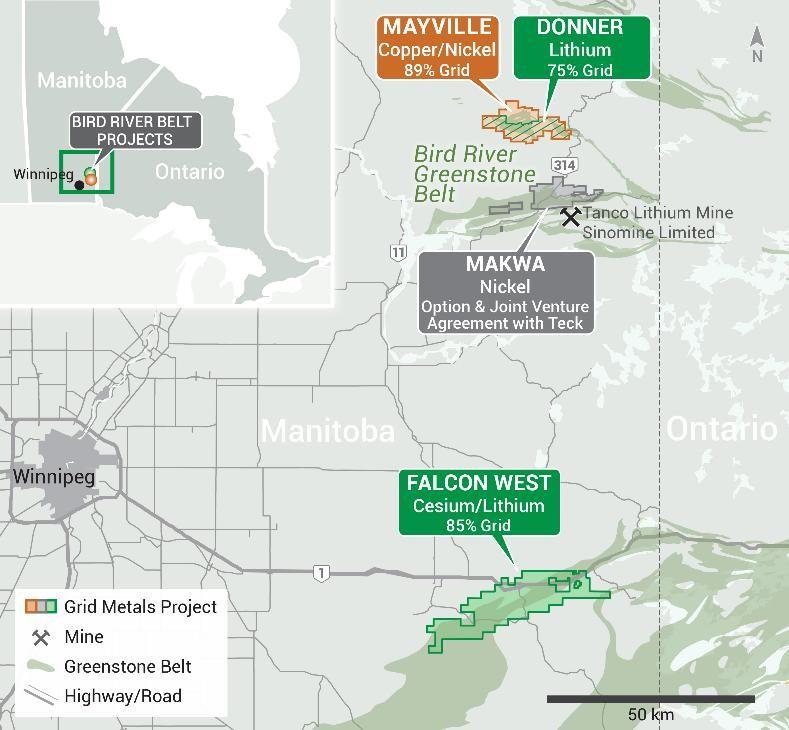
Grid’s crown jewel, its Falcon West project, located 130 km from Winnipeg and only 500 m off the Trans-Canada highway, hosts widespread cesium mineralization in pollucite, the preferred vehicle for the critical mineral given concentrations that can exceed 30% cesium oxide (Cs2O). Most of this mineralization sits conveniently and cost-effectively within 25 m of surface, potentially enabling an open-pit mining scenario.
Falcon West’s main target, the Lucy South pegmatite, is a ~10 metre-thick, near surface, highly fractionated cesium-lithium-tantalum-enriched pegmatite body containing a discrete pollucite-rich zone. The company just announced a maiden cesium mineral resource estimate (MRE) with an open-pit measured resource of 51,500 tonnes at 2.6% Cs2O and 1.5% lithium dioxide (Li2O), with a high-grade cesium-bearing pollucite zone containing a resource of 15,600 tonnes at 5.2% Cs2O and 1.8% Li2O.
This equates to total contained metal in the measured category of 1,322 tonnes Cs2O, which firmly establishes Lucy South as the second-largest cesium resource being actively developed globally by Western-domiciled exploration and development companies, well ahead of Power Metals’ Case Lake project in Ontario with a resource estimate of 13,000 tonnes at 2.40% Cs2O for 330 tonnes Cs2O.
The company supported these findings with a 3,000-m phase 1 drilling program, highlighted by 1.2 m at 27.1% Cs2O (LU25-08) in December 2025, 0.53 m at 30.43% Cs2O in February 2026 and 2.35 m at 28.4% Cs2O reported later that month – among the highest-grade intercepts reported globally in recent years – complemented by high-grade lithium and rubidium, delineating a more than 120 m by 60 m mineralized area beginning at surface and open in multiple directions.
A phase 2 drilling program, also spanning 3,000 m, kicked off in January 2026 to build upon phase-1 learnings, yielding highlights of 1.6 m at 26.5% Cs2O from 19.6 m and 1 m at 13.8% Cs2O in April, enhanced by significant intercepts of tantalum, lithium and rubidium, expanding known mineralization up to 70 m to the east.
A second batch of phase 2 assays hit the wire in May, yielding a highlight of 0.35 m at 15.1% Cs2O from 26.1 m, plus elevated lithium grades across numerous intercepts, with drilling successfully extending known cesium mineralization by 75 m to the north.
Grid’s validation of Lucy’s historical prospectivity did not go unnoticed, prompting Avenir Minerals, a subsidiary of Agnico Eagle Mines (TSX:AEM), to take a 15% stake in Falcon West for C$3.75 million, with an option to increase that figure to 30% upon a finalized mine plan or preliminary economic assessment, reinforcing the project’s development journey with guidance from one of the world’s top mining companies.
Avenir currently owns 9.9% of Grid’s common shares and has the option to increase its interest to 19.99% starting 15 days following the release of the MRE at Falcon West, which brings us to October 15, 2026. This potential near-term catalyst coincides with initial permitting and metallurgical work, which is expected to ramp up in Q4.
Soon after, in Q1 2027, drills will spin again focused on numerous pollucite and spodumene occurrences that remain to be validated in and around the historical resource based on available magnetic survey, historical drilling, bedrock and geochemical survey data, in addition to an outcropping area of a lithium-cesium-tantalum pegmatite similar to Lucy about 1 km to the west backed by a magnetic low anomaly.
In this way, with a defined resource estimate and several high-grade avenues to expand mineralization in hand, the company is making a concerted effort to establish a dominant position in the cesium market among only a few peers, differentiating itself as a reliable ex-China lifeline to potential partners across the world.
Grid supplements Falcon West’s data-driven pathway into the concentrated cesium market with a pair of high-upside projects, de-risked by strong partnerships, that set the stage for the company to meaningfully expand its capacity for value creation.
The Donner lithium property
Grid’s 75%-owned Donner property, prospective for lithium, embodies the old adage, ‘if you can’t beat ’em, join ’em,’ through a toll-milling MOU signed in 2022 with the Tantalum Mining Corporation of Canada – the operating company behind Sinomine’s Tanco mine – that contemplated supplying material from the Donner lithium deposit to be toll-milled at Tanco. This deal was signed before the collapse in lithium prices, but with prices having rebounded significantly off the lows seen in the summer of 2025, there is potential for Grid to generate value from this forgotten asset.
Donner contains a resource of 6.8 million tonnes grading 1.39% Li2O, which sits approximately 30 km from Tanco’s lithium circuit. With Tanco considering the building of a new plant to reprocess tailings and increase capacity at the site, this could bode well for a definitive agreement between Grid and Tanco.
The Makwa nickel project
Grid further diversifies its critical minerals exposure with the Makwa project, whose high-grade and underexplored polymetallic resource, estimated in 2024 at 14.2 million tonnes grading 0.75% nickel equivalent, aligns the company with the metal’s US$50 billion tailwind, as nickel users across the stainless steel and battery technology industries scramble to secure supply in danger of dipping into a near-term deficit.
The property, only 145 km from Winnipeg, hosts two past-producing nickel sulfide mines, three pit-constrained nickel resources and numerous high-grade nickel and/or copper surface showings, whose development is supported by readily accessible infrastructure, including all-season roads, hydro-electric power and nearby transcontinental rail.
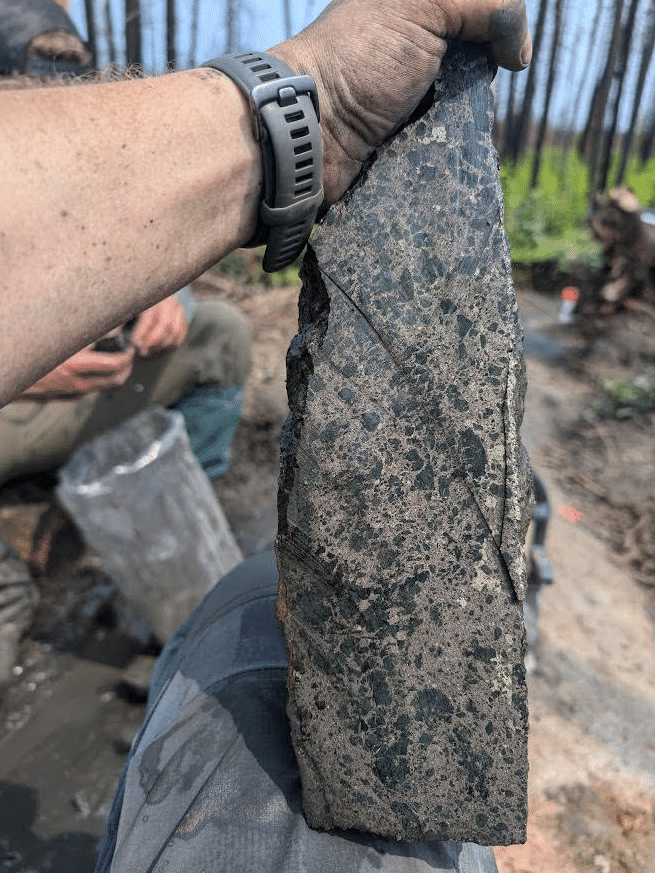
In 2024, Grid de-risked Makwa’s robust exploration database through a C$17.3 million option and joint venture agreement with Teck Resources (TSX:TECK.A), one of Canada’s premier base metal miners, to optimize for the discovery of a nickel, copper, cobalt and platinum group elements (PGE) deposit of global significance.
Initial exploration under the agreement, which establishes a framework for Teck to acquire an up to 70% interest in the project, led to a discovery yielding up to 1.1% nickel in grab samples reported in August 2025 associated with the Pavo anomaly, a shallow electromagnetic (EM) conductor extending for about 600 m in strike length outlined from an airborne geophysical survey in late 2024.
The partners then secured drilling and geophysics permits for Pavo and mobilized a drill rig to site, as per a November 2025 update, with drilling eventually yielding numerous narrow intervals of sulfide mineralization over a strike length of ~250 m, up to ~150 m deep, leaving several high-priority targets still to be tested, including a deeper EM anomaly at Pavo modelled to host higher nickel tenors, as well as a separate EM anomaly discovered in Q1 2026 at the nearby Ore Fault deposit backed by historical drilling up to 15 m at 1.71% nickel and 1.76 g/t palladium from 187 m deep.
An abundance of unrecognized upside
The overarching risk of investing in exploration and development-stage mining companies is that projects fail to demonstrate their value, amounting to little more than dirt and holes in the ground, a fate evidenced by the Prospectors & Developers Association of Canada noting that only 1 out of 10,000 mineral prospects will go on to become a full-fledged mine.
As we’ve shown in this article, Grid dispenses with this risk in short order, proving itself to be a company that goes the extra mile when it comes to reinforcing its path forward, ticking off the boxes any market-tested investor would include in their due diligence process, such as:
- Strategically chosen target commodities encompassing a collectively multi-billion-dollar tailwind, including cesium, lithium, copper, nickel, cobalt and PGE.
- High-conviction projects backed by historical resources, Falcon West’s globally significant resource and extensive high-grade exploration results open for expansion. To the trio of promising projects profiled above, we can add the Thompson East project, on which Boliden (USOTC:BLIDF) has a C$10.1 million option to acquire an 80% stake, joining the companies’ forces in search of a top-tier nickel, copper, cobalt and PGE discovery. There’s also the Mayville project, whose open-pit resource is estimated at 32 million tonnes at 0.61% copper equivalent, complemented by several shallow sulfide targets still to be tested across the property.
- Industry-leading partners, including Avenir, a subsidiary of Agnico Eagle, Teck and Boliden, whose contributions to the mining industry have generated more than C$200 billion in market capitalization.
- Cash to fund exploration programs, justify development work and usher the project portfolio farther along the mining lifecycle, with about C$30 million in cash and exploration expenditures covered under the partnerships we’ve discussed.
Yet, despite Grid’s ironclad business plan, brimming with optionality for uncovering new mineralization, the stock has yet to reflect the promise of its underlying company, with many investors likely waiting on the sidelines for projects to bear fully-formed fruit, an understandable stance given the volatility that is part and parcel of pre-revenue operations.
Nevertheless, if you’ve read until this point, you know Grid’s orchard, so to speak, has been coming along nicely over the past few years, and that the harvest is positioned to be plentiful in the months and years ahead, making it an optimal time to build exposure to the company.
Sponsored Article: InvestorsHub.com Inc. dba The Market Link has been compensated [CASH: $3,523.25 by [Grid Metals Corp.] ([Exchange: (OTCQB:MSMGF) for the publication and distribution of this content. This is not independent editorial content. For full compensation disclosure visit investorshub.advfn.com/boards/disclaimer.aspx.