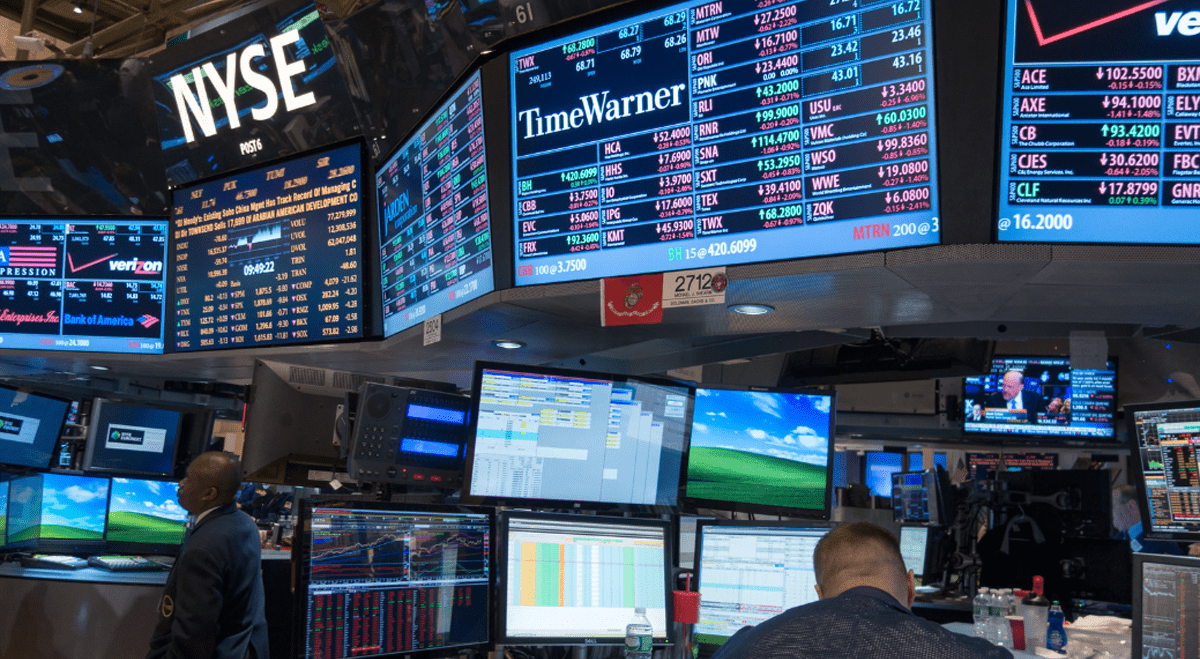
US stock futures moved lower on Thursday as concerns about artificial intelligence valuations, corporate borrowing and the prospect of higher interest rates continued to weigh on investor sentiment, despite reports of strong revenue growth at Anthropic and record quarterly earnings from Taiwan Semiconductor Manufacturing Company.
At 02:54 ET (06:54 GMT), Dow Jones futures were up 27 points, or 0.1%, while S&P 500 futures declined 38 points, or 0.5%. Nasdaq 100 futures fell 407 points, or 1.4%, indicating continued pressure on technology stocks ahead of the opening bell.
The weakness followed a sharp decline on Wall Street during the previous session, when stronger-than-expected US inflation data prompted investors to reassess the outlook for Federal Reserve interest rates.
The S&P 500 and Nasdaq Composite recorded their largest single-session declines since July, with AI-related companies particularly affected.
AI Investment Concerns Weigh on Technology Stocks
Wednesday’s market sell-off followed the release of US consumer price data showing a larger-than-anticipated increase in September inflation.
The figures prompted investors to increase expectations of a possible Federal Reserve interest rate rise at its meeting later this month, driving US Treasury yields higher and putting pressure on equity valuations.
Government bond selling moderated later in the session, with analysts suggesting that some investors were moving away from riskier AI-related equities and towards US government debt.
Concerns have also increased about the sustainability of large-scale borrowing used to finance artificial intelligence infrastructure, particularly as financing costs remain elevated and competition within the sector intensifies.
CoreWeave (NASDAQ:CRWV), a cloud infrastructure company with significant exposure to AI computing demand, was among the hardest hit.
Its shares declined more than 15%, while some of the company’s bonds fell to new lows in secondary market trading.
The movements highlighted growing investor attention to the financial risks associated with debt-funded expansion across the AI industry.
Anthropic Reports 45% Quarterly Revenue Growth, According to Media Reports
Anthropic (NASDAQ:ANTP) reportedly told institutional investors on Wednesday that its third-quarter revenue increased 45% to approximately $16.8 billion.
According to The Wall Street Journal, the developer of the Claude AI chatbot previously recorded revenue of $11.6 billion in the second quarter and less than $5 billion in the first quarter.
The figures suggest that demand for Anthropic’s AI products continued to expand substantially, although the pace of quarterly growth slowed.
Analysts at Vital Knowledge noted that the reported increase would be considered particularly strong in most industries, but that expectations for AI companies have become unusually demanding.
The analysts said that such growth would be welcomed “in any normal world”, while warning that slowing growth rates could affect investor sentiment.
“In the land of AI, where investors are used to parabolic figures, a slowdown in growth undercuts sentiment,” the analysts wrote.
The reported figures have attracted attention amid expectations surrounding Anthropic’s potential initial public offering.
According to The Wall Street Journal, the company is considering raising as much as $100 billion at a valuation of approximately $2 trillion.
No definitive timetable for the proposed listing has been announced, although the report indicated that Anthropic could disclose further operational details in IPO-related documentation over the coming weeks.
TSMC Posts Record Profit as AI Chip Demand Remains Strong
Taiwan Semiconductor Manufacturing Company (NYSE:TSM) reported record quarterly profit, providing evidence of continued demand for the semiconductor technology supporting artificial intelligence infrastructure.
The world’s largest contract chip manufacturer recorded net profit of NT$763.06 billion for the three months ended 30 September, an increase of 69% compared with the same period last year.
The result exceeded the NT$746.3 billion forecast based on LSEG estimates cited by Reuters.
Quarterly revenue rose 50% to NT$1.49 trillion.
TSMC reported a gross profit margin of 66.4%, an operating margin of 58.7% and a net profit margin of 51.1%.
The company also indicated that it had considered expanding its manufacturing presence in the United States, potentially through additional facilities in Texas.
The proposed expansion would support efforts to increase production capacity as demand for advanced semiconductors continues to grow.
TSMC’s results contrasted with the weakness in AI-related equities, highlighting the difference between underlying demand for computing infrastructure and investor concerns about valuations and financing.
US Producer Price Data in Focus Ahead of Federal Reserve Meeting
Investors were also awaiting the release of September’s US producer price index, which could provide further information about inflationary pressures.
Economists expected producer prices for final demand to increase 0.6% month-on-month, compared with a 0.4% rise in August.
On an annual basis, producer price inflation was forecast at 5.3%, slightly below the previous reading of 5.4%.
The figures follow Wednesday’s stronger-than-expected consumer price report, which highlighted the impact of rising energy costs associated with the conflict involving Iran.
The latest inflation data will be particularly important ahead of the Federal Reserve’s two-day policy meeting on 27–28 October.
Investors will also monitor upcoming US retail sales figures and initial unemployment claims for additional indications of economic activity and labour market conditions.
Oil Prices Decline Despite Continued Middle East Shipping Risks
Oil prices fell on Thursday as traders assessed continuing threats to energy shipments through the Strait of Hormuz alongside reports that the United States could consider easing sanctions affecting certain oil transport vessels.
At 03:35 ET, Brent crude futures were down 1.9% at $104.02 per barrel, while West Texas Intermediate futures declined 1.1% to $94.04 per barrel.
According to maritime officials cited by Reuters, two commercial vessels sank near the Strait of Hormuz during the preceding 24 hours after being struck by separate projectiles.
Attacks on shipping in the region have increased concerns about disruptions to oil exports from the Persian Gulf.
Meanwhile, fighting involving Saudi Arabia and Houthi militants in Yemen has raised additional concerns about the security of shipping routes through the Bab el-Mandeb Strait, which connects the Red Sea with the Gulf of Aden.
Reports also indicated that US President Donald Trump was considering easing sanctions on certain vessels operating within the so-called shadow fleet, which transports oil and petroleum products from sanctioned countries, including Russia, Iran and Venezuela.
Such a move could be intended to reduce shipping costs and alleviate some of the pressure on global energy markets.
Despite Thursday’s decline, oil prices remained elevated, with geopolitical supply risks continuing to influence inflation expectations and financial market sentiment.