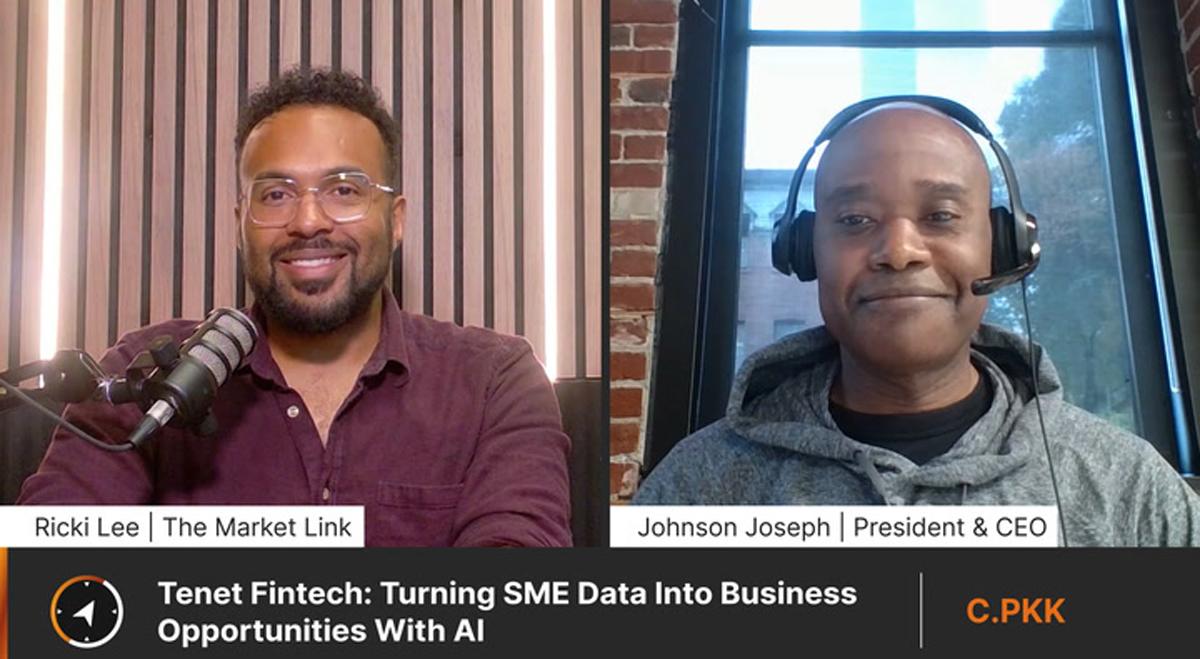
Ricki:
In this global trade war context, there’s been a lot of talk recently about the need for small businesses to find new opportunities. Unfortunately, many of them don’t know where to start. What if the whole process of helping small businesses find their next customer, supplier, or business opportunity was fully automated using AI, which is another thing we’ve been hearing a lot about recently. Hello, I’m Ricki Lee, and this is The Capital Compass. Today, we’re looking at Tenet FinTech Group, a technology company building an AI-powered ecosystem around small and medium-sized businesses. At the center of that strategy is the Cubeler Business Hub, a platform that connects to participating companies, financial and operational data, and uses artificial intelligence to identify potential business opportunities. Tenet is now expanding that ecosystem internationally while also developing ways to turn the growing pool of business data into commercial intelligence products.
How does the model actually work and where does Tenet ultimately make its money? Joining me today to explain is Johnson Joseph, president and CEO of Tenet FinTech Group. Johnson, welcome to the Capital Compass.
This article is disseminated in partnership with [Tenet Fintech Group Inc]. It is intended to inform investors and should not be taken as a recommendation or financial advice.
Johnson:
Hi, Ricki. Thanks for having me.
Ricki:
It’s a pleasure to have you with us. Tell us, Johnson, let’s start with the basics. For someone discovering Tenet for the first time, what is the Cubeler Business Hub? What problem does it solve for SMEs? And ultimately, how does Tenet make money from the ecosystem it’s building?
Johnson:
Sure. First and foremost, the Cubeler Business Hub is a business development platform for SMEs. Its goal is to provide SMEs with everything they need to grow their businesses. Everything is based on data, AI, and analytics. First, the SMEs register on the platform and share their financial data with the platform. Using that data, the platform then offers SMEs a series of products and solutions to help them promote and grow their businesses. The products and services are offered under four main pillars or modules. The first module is the networking module. Essentially, what we allowed SMEs to do is to make connections that would be valuable to their businesses. The second module is the advertising module where we help SMEs promote their products and services. The third module is the insights module where SMEs can find news, insights, market intelligence related to their industries.
Johnson:
Finally, the fourth module is the financing module where we help our SMEs find credit, loans, and government grants. Essentially the Cubeler platform provides SMEs with everything that any business would need to grow and advance their businesses.
Ricki:
Cubeler 2.0 introduced a Gentech AI that can analyze a company’s data and proactively identify potential customers, suppliers, partnerships, other opportunities, many of which you just described. Can you give us a real-world example of how that actually works and what makes Cubeler fundamentally different from a traditional business networking platform?
Johnson:
Okay. It’s really all about AI. As you mentioned, at the beginning there’s been a lot of talk lately about AI, and rightfully so. It changes everything. The whole process, the way we use AI is that it automates everything. When it comes to networking, I’ll give you a concrete example. I was watching the news a few weeks ago, and obviously we’re in an era where, where there are tariffs. There was a small business out west that had lost their supplier. It was a US supplier of cardboard boxes, and they had to go through all kinds of difficulties just trying to find another supplier. Now, they had all these products, essentially. Can you imagine that? All these products and no boxes really to put the products in, and to ship them.
Johnson:
Now, had that business been registered on Cubler, they would have easily just been able to go on through the dashboard and it would be a simple wiki as, “Okay, click, let’s see the suppliers that are matched with my business. Boom, I’m going to select this one.” Essentially, that’s what it comes down to. It automates the process of finding, , whether it’s clients, suppliers, partners, everything uses data and analytics and artificial intelligence to automate everything for small businesses. That’s how we’re different.
Ricki:
You’re also expanding the ecosystem internationally, including bringing Chinese import/export businesses onto Cubeler through partners such as Shanghai Guiqi Trading. Why is connecting those businesses with Canadian and US SME strategically important? What does the platform become more valuable to you as you add more companies, markets, and transaction data?
Johnson:
Sure. For those who are not familiar with the company, we’ve been operating in China for a number of years now. We’ve had an opportunity to make a lot of connections, which we believe could be extremely valuable to businesses in Canada and in the US as well. Now, we’ve established a pretty strong distribution network in China through our partners. Now what we were able to do through the Cubeler platform is for registered businesses, we can now give them access to the Chinese market. Imagine now, if you’re a small business, you could be a local business in the Toronto area, Vancouver, Montreal, or wherever in Canada, or the US for that matter. All of a sudden, just by being a member on the platform, we give you access to the Shanghai market. All of a sudden, you’re selling your products in Beijing, Nanjing.
Johnson:
That’s the value that we would be bringing to businesses that some businesses may not have dreamed of being able to sell their products in China, but through the Business Hub and our distribution partners, they can. Now, what does that mean for clients and why does it make the platform more valuable? Now, as we continue to grow the platform locally and internationally, all of a sudden now, we’re gathering data, right, because that’s what we do on the platform. The more data we gather, Ricki, the more insights we’re able to provide through our data products that we’re going to be commercializing later on this year. Providing economic indicators, everything goes through, the small businesses and their operations on the Cubeler platform.
Ricki:
Sounds very exciting indeed. Another important piece of the strategy is Gold River, where you recently announced an agreement expected to generate at least 225 million Canadian dollars in annual purchases over three years. How does Gold River fit alongside Cubeler? And importantly, for investors, how does that level of commercial activity translate into revenue and value for Tenet itself?
Johnson:
All of the services that I mentioned earlier through the Cubeler platform are offered completely free of charge, right? The only thing that we ask the small businesses is to connect their accounting software to the platform and give us access to their data so that we can read and analyze the data. Now, when it comes to Gold River, Gold River is connected to the Cubeler platform in the sense that the businesses still have to connect on the Cubeler platform. Now, Gold River specifically caters to supply chain related businesses. I’m talking clients and suppliers of supply chain related products. Now, the difference between Gold River and Cubler is that on the Gold River platform, the platform facilitates specific transactions related to the supply chain. Now, when a supplier gets matched with a client through Gold River and a transaction happens, then we charge a fee.
Johnson:
I should also mention that Gold River operates exclusively in China right now for the time being. Now, there might be a possibility to bring that to North America as well, but for the time being, it’s exclusively in China and it accounts for most of the company’s revenue right now.
Ricki:
Okay. Finally, Johnson, data seems to be the common thread connecting all of this is what you’re telling me. As the ecosystem grows, what kinds of commercial intelligence products can you ultimately build using this data? Over the next sort of 12 to 18 months, what metrics should investors watch to judge whether the strategy is actually working?
Johnson:
Small and medium-sized businesses are the backbone of economies around the world, right? I mean, they account for 82, depending on what country, they account for 75 to 80, sometimes even 90% of GDP, right? Economic data coming from small and medium-sized businesses is extremely valuable, and that’s the business that we’re in. We’re gathering all of this information directly through the accounting software systems of the small and medium-sized businesses. This allows us to create macroeconomic indicators. We’re building a series of economic indexes based on all of the small and medium-sized business data that we’re gathering. For example, we’re going to be coming out in few weeks or maybe a month from now, we’ll be coming out with our first series of indexes. For example, we’ll have Canadian Retail Sales Index, we’ll have Canadian Retail Inventory Index, we’ll have Canadian manufacturing cash balances.
Johnson:
We have all of these indexes. We have all of these economic indicators that we’re going to be able to come out with. Now, what’s interesting about these products, Ricki, is that Statistics Canada here that publishes macroeconomic data every single month, right? For example, retail sales, I think it’s October 15th right now, or 16th, excuse me. October 16th, Statistics Canada just came out with the retail sales figures for the month of August. The data is six weeks old. Now, with our new products, we’re going to be able to come out with indexes that are provided almost in near real time. Every day, our subscribers are going be able to follow along and see, “Hey, what are retail sales doing across the country or in a specific province? How are inventory levels fluctuating on a daily basis? We’ll be able to provide this information on a daily basis, and that makes a huge difference for the clients that we’re targeting with these products.
Johnson:
Capital markets, governments, banks, any kinds of clients of that nature who are looking for this kind of economic insight will be able to subscribe to our products. Essentially, that’s where we’re going. In terms of metrics that investors could be looking for in the next 12 to 18 months first and foremost, I would say keep an eye on the growth of the Business Hub membership itself, because we’re going to be publishing how many members are joining the platform every single month, okay? The second thing people should be looking out for is obviously in the quarterly financials, right? We’re going to be coming out with our third quarter numbers by the middle or end of November. That should be an indicator for investors and potential for potential investors and our current shareholders to see whether or not the company is being successful.
Johnson:
After that, obviously, I come in the year-end results and then the quarterly results, 2027 and going forward.
Ricki:
Well, Johnson, thank you so much for joining us today and giving us a closer look at the strategy behind Tenet FinTech Group.
Johnson:
My pleasure. Hopefully, we can do this soon. I’d love to come back and provide updates on where we are with the operations of the company.
Ricki:
Absolutely. We’ll be so glad to have you back. In the meantime, for more information, you can visit www.tenetfintech.com. I’m Ricki Lee, and this has been the Capital Compass. Thank you all for watching, and we’ll see you again next time.
Sponsored Article: InvestorsHub.com Inc. dba The Market Link has been compensated CASH: $3,000 cash by [Tenet Fintech Group Inc] (CSE:PKK) (USOTC:PKKFF) for the publication and distribution of this content. This is not independent editorial content. For full compensation disclosure visit investorshub.advfn.com/boards/disclaimer.aspx