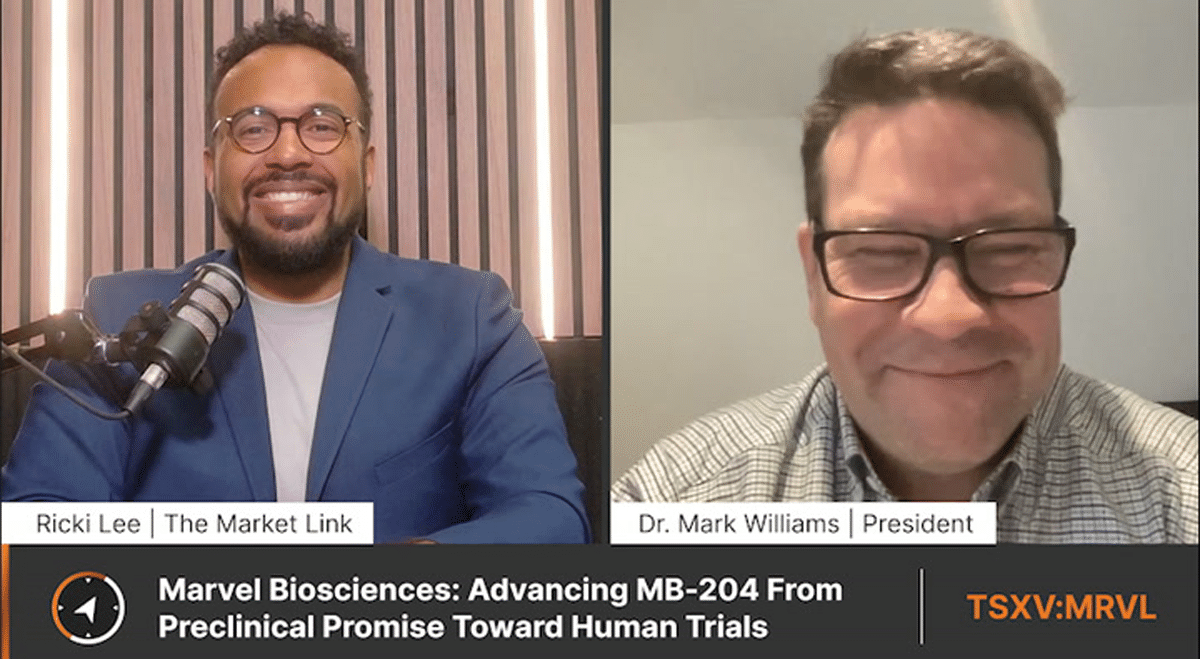
Marvel Biosciences’ Director (USOTC:MBCOF) (TSXV:MRVL) discusses MB-204, its autism research and upcoming Phase 1 human trials.
Ricki:
What if a treatment originally developed for Parkinson’s disease could help unlock a new approach to autism and other neurodevelopmental disorders? Hello, I’m Ricki Lee, and this is The Capital Compass. Today, we’re looking at Marvel Biosciences, a Canadian biotechnology company developing MB-204, an experimental drug designed to block the adenosine A2A receptor, which plays a role in regulating brain activity. MB-204 is based on an existing Parkinson’s drug called Istradefylline, which I hope I pronounced correctly, but Marvel has modified the compound in hopes of improving its therapeutic potential. The company has reported encouraging results across several preclinical models of neurodevelopmental disorders, including its latest study involving SHANK3, a gene associated with certain forms of autism. With preparations underway for phase one human trials, Marvel is now approaching a significant transition in its development program. Joining me today to discuss the science and what comes next is Dr. Mark Williams, President, Chief Science Officer, and Director of Marvel Biosciences. Mark, that was a mouthful. Welcome to the Capital Compass.
This article is disseminated in partnership with Marvel Biosciences Corp. It is intended to inform investors and should not be taken as a recommendation or financial advice.
Dr. Mark:
Thanks, Ricki, you did that very well. <Laugh>
Ricki:
Mark, let’s start with the science itself. What exactly is MB-204 and how could targeting the adenosine A2A receptor help address some of the behavioral and social challenges associated with autism?
Dr. Mark:
That’s great. Thanks for the question. Istradefylline was an interesting molecule that we based our drug of, on, and it’s approved for the treatment of Parkinson’s, as you said, and we made a very specific logical change to it. We, what’s called fluorinated the molecule, which is often done to improve the stability of molecules in the body and improve how well they’re absorbed orally when you take it as a, say a pill. Actually, istradefylline itself is based off caffeine, which is a known adenosine A2A antagonist itself and has benefits above and beyond just simply waking you up in the morning. What we found is, and actually some of our collaborators in France found is that there is a imbalance in a reward pathway in the brain. People with autism, and actually we also believe depression, don’t get a reward from social interaction normally.
But if you block the adenosine A2A receptors, suddenly this reward pathway is now activated and you can get what looks to be almost very, very quick, profound changes in behavior in animal models for autism. We think it’s very broad as well because this idea of a pathway could apply to multiple diseases, multiple neurodevelopmental and forms of autism.
Ricki:
Wow, interesting stuff. Your latest SHANK3 study showed MB-204 matching or outperforming its parent compound, istradefylline, kind of what you alluded to just there, across most of the behavioral measures tested.
Dr. Mark:
That’s right.
Ricki:
What stood out to you in those results and what advantages could MB-204 offer over the original drug? You kind of alluded to it there. I wonder if you could go into a bit more detail.
Dr. Mark:
We tested basically… istradefylline, as you know, is used to treat Parkinson’s. There’s a limit as to how much you can give to it before it starts triggering sort of, non-specific activity in the animal. They become kind of hyper in a sense, right? Kind of as if you take too much coffee in the morning, you kind of get hyper, you get hyperactivated and so forth. We wanted to keep the dose of the istradefylline at a level where that didn’t occur. And what we found is that there was a good effect seen with istradefylline, that was key. With our MB-204, we could actually dose to higher levels, and we saw even better results in almost every single measurement. In fact, in earlier studies, we were actually able to, because we were able to dose our drug to higher levels than you would normally would with istradefylline, we actually in some cases saw the autistic animals being more sociable than normal animals while on our drug.
It’s a very, that was never seen before as far as we could tell with istradefylline. We’re very excited about that finding. It’s, it appears clear that our MB-204 really is well suited to non-Parkinson’s diseases such as autism and some of the neurodevelopmental issues that that we’ve tested.
Ricki:
This is really fascinating stuff. You’ve also seen encouraging results across several different genetic models, including Rett syndrome and fragile X. Why is that consistency important and what could it tell us about MB-204’s potential beyond a single neurodevelopmental disorder?
Dr. Mark:
It suggests that it could be sort of what we call a pan-spectrum treatment for autism. There’s multiple things that are involved, but specifically in the case of Rett and Fragile X, we actually did something very interesting, which is we treated the animals for two weeks, then stopped treatment. We actually still saw long-acting effects well after the drug is totally out of the body, or in this case, the animal. Two to three weeks later, suggesting that there may be some sort of semi-permanent changes here. Again, this idea of if we’re able to restore the reward pathway in animals, which we think we will do in people as well, this is why anywhere where you see people are not as sociable as they would normally otherwise be, this could go after that.
That touches on multiple forms of autism and autism in general, as well as some of those neurodevelopmental conditions such as Rett and Fragile X
Ricki:
Wow. Well, on top of that, you’re also preparing to take MB-204 into phase one clinical trials, moving from lab research into human testing, which is what we’re kind of all gearing up towards. What are you hoping to establish in those first trials, and what would a successful phase one mean for the program?
Dr. Mark:
What was interesting is that, when we looked at animals in multiple models and multiple labs, by the way, within an hour of giving MB-204, we could see these profound changes in animals. It turns out someone did a study with istradefylline and showed a single dose of istradefylline in even healthy volunteers. They biased towards a more sociable interaction with other people. I won’t go into the details of that, but what it suggests is that, even after a single dose, you might be able to see a benefit with this adenosine A2A antagonism. We’re going to test normally for safety and make sure the drug is well absorbed in healthy volunteers, but also look at some of these endpoints where we can say, okay, are people sort of seeing social situations more positively?
That’s one thing. The other thing is, and I’m sure if you’re a big coffee drinker in the morning, you do that because it helps you wake up and become more focused. That’s very easy to test in the clinic, and we believe that MB-204 will improve focusing as well, attention and focus. We can test that even after a single dose in patients and in healthy volunteers. What that means is that if we can show that even after a single dose, the drug looks like it’s not only safe but looks like it potentially could have some benefits. I mean, this could have tremendous interest in the company from the larger pharmaceutical companies and help us to really push this compound forward into additional clinical trials and so forth. Not only that, but clearly for investors, convince the market, broad market, that this is a very exciting compound.
Ricki:
Mark, with all of that combined, what should investors be looking for over the next sort of 12 to four months? What are the biggest milestones that investors should be watching for as MB-204 moves toward clinical development?
Dr. Mark:
There’s very sort of fixed recipe-like things that we need to do, things like submit for ethics approval, ethics submission, first patient screen, first patient enrolled, and so forth. Those are just sort of steps, first patient dose, last patient out, that kind of thing. Then data. Data we expect in about four to five months from initiation from the ethics approval. Also, we’re looking at getting the word out. We intend to go to several different conferences where we’re going to get the science out, as well as expand our advisory board and meet with the FDA. These are all things that we’re planning that we’d like to do. These are all meaningful things towards you. We’re really building a robust program in the autism space that we think will gather a lot of attention, both scientifically and commercially as well.
Ricki:
Wow, Mark, thank you for joining us today. I’m just picturing a room full of mice that I’m just, like, don’t talk to me. I haven’t had my coffee yet this morning.
Dr. Mark:
Well hopefully MB-204. <Laugh>
Ricki:
Exactly. Absolutely. <Laugh>. Thank you for joining us and giving us a closer look at the science and potential behind MB-204, Mark.
Dr. Mark:
Thank you for your time.
Ricki:
For more information about Marvel Biosciences and its development programs, visit www.marvelbiotechnology.com. I’m Ricki Lee, and this has been The Capital Compass. Thank you for watching, and we’ll see you again next time.
Sponsored Article: InvestorsHub.com Inc. dba The Market Link has been compensated CASH: $2,138.13 / by Marvel Biosciences Corp. (TSXV:MRVL) (USOTC:MBCOF) for the publication and distribution of this content. This is not independent editorial content. For full compensation disclosure visit investorshub.advfn.com/boards/disclaimer.aspx