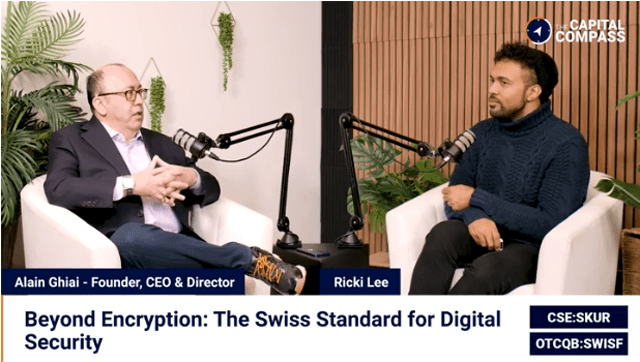
Hello, I’m Ricki Lee and this is the Capital Compass. Today we’re looking at Sekur Private Data (USOTC:SWISF) (CSE:SKUR). A company focused on sovereign encrypted communication at a time when cyber attacks on US agencies are accelerating.
Just in the past few weeks, a federal breach exposed citizens contact information and signal experienced a major outage. Both incidents highlight one thing. Even secure systems can be fragile when they depend on outside infrastructure.
Secure has just announced a new partnership with Quaestor Federal Consulting, a move that positions the company more directly inside the US government procurement ecosystem.
Joining me now is Alain Gaia, founder, CEO, and director at Sekur Private Data. Alain, welcome to the Capital Compass.
Alain: Thanks for having me.
Ricki: It’s a pleasure to have you. So a recent federal breach exposed Citizens contact information. What does this tell us agencies about the fragility of secure systems and how can encrypted sovereign platforms prevent similar failures?
Alain: Well, the big issue is that we are all using, and definitely the governments worldwide are using the same big tech companies. So you used to have the big four in the car industry. Now you have the big four or five in technology.
Over the last decade there have been many compromises and many outsiders working on software apps, et cetera. So this compromises the whole system. It’s no longer as secure and definitely not private. Big tech’s business model is to sell your data, and when that happens, you are bound to have some hackers.
As far as sovereignty, when we deal with the government, we, by the way, we ship our server what we call on premise, if not having a Swiss infrastructure fully independent with our own server outside of big tech, outside of these cloud companies, definitely gives you that multiple layers of security and also privacy.
Ricki: And so on that note, the outage caused at Signal was basically because of its reliance on AWS. Right? So that shows even privacy apps depend on big tech, like you just said. So does this prove that true security requires infrastructure independence, especially for US government buyers?
Alain: It requires independent infrastructure, but also the software itself, the AWS outage was caused by another application. You have hundreds of thousands of apps running on AWS if some of them are misconfigured, it could create a glitch in the big thing.
So it’s not like they were hacked. The whole thing crashed because of another app. As far as Signal and all these other chat application, the big issue is not just the infrastructure, it’s also how you sign up and what kind of info you give.
You notice you’ll have to put your phone number and then the data mine, your address book and everything is synchronized. Synchronization is the death of security and privacy. So all these messaging apps have the same issue because you have to divulge your phone number.
That is the first entry point to any hacker as opposed to, let’s say, Sekur Messenger, which is not using your phone numbe.
Ricki: Wow. That does not bode well for convenience.
Alain: No. And they use AI on top of it now in it, so it makes it a lot worse.
Ricki: Right. So with the new contract with Quaestor Federal, then how do you see the future of Sekur evolving in the government sales space?
Alain: Well, we announced recently our national Security team creation, which is composed of the ex CIO of the US State Department, the previous Chief Technology Officer of the CIA technology labs. You can call him the most important IT guy in the country.
And also our partner Phil Oakley, who has 30 years of military intelligence. You can all go to the press release and read more about them. We are very excited because entities and governments are looking for outside of the box solutions.
Obviously, these are not working for them. So we’re very privileged that they found Sekur as a big benefit. So I think for Sekur, it’s going to be a whole new chapter where we sell to the US government through a GSA schedule, which is basically being on the platform of the government purchase entity, which we are in process of being.
Then other governments can come in as well because it’s an amazing validation to have achieved that. So we are, we’re kind of the off grid independent company as opposed to being just another app on big tech. And this is also something that they’re looking at.
Ricki: Okay, so I often look for the Swiss label on my chocolate, but operating under Swiss data law is also often cited as a trust advantage. So for US federal and state procurements, how meaningful is Swiss hosted when agencies must consider jurisdiction legal access and supply chain risk for these US agency?
Alain: When you’re looking at federal and state, Central Intelligence, Department of Homeland being in Switzerland is not going to work. So what we do is we install a machine, we call it on-prem, on-premise, and the server infrastructure is in the US in locations that we will not be able to disclose and we manage the software. Even in the future. It could be that they may manage the software and give us a fixed fee every year for outside of federal agencies. Sometime you have state and local agencies. Having your own infrastructure in Switzerland is definitely a huge thing because you’re not going on AWS or Google infrastructure with tens of thousands of other apps and other people playing around with the infrastructure. So for federal, definitely it has to be on premise. Other countries have similar rules, state and local, maybe not. But for the average user or a corporate user, we just launched our corporate solution for C-level, high net worth individuals. Having a Swiss separated private server environment is very unique and very valuable.
Ricki: Amazing. So you earlier you mentioned AI when we spoke about Signal and the convenience of synchronizing data, et cetera. So with the rise of AI use in cyber crime, which is well documented, what is secure doing to counter those kinds of threats?
Alain: Well, it may not be popular, but we don’t put AI in our infrastructure because AI essentially is taking information of your habits, your text, your location, what you do, what you eat, where you bank, and that information is being processed.
And even if the companies have the best intention of keeping this secure, the hackers are almost always smarter. So they will steal that.
We pride ourself not to have AI in our communication suite, whether it’s the email, the messenger, the VPN, we’re launching encrypted voice and video as well at the end of February. And all our all our applications work with non-Sekur users.
If you go on an Android, you have Google message. Now, I just realized and kind of panicked me because it’s not like the old text message now. It’s literally someplace everything I do and I say. AI is building profiles on people and hackers can come in, take advantage of that, and then steal your money, do other stuff.
So we are very much anti AI in our communication suite. And that’s also another thing that Ken Rogers from the state department who retired a year ago, was very attracted to as part of a national security team. And he really liked that we don’t embed AI everywhere.
Ricki: So as well as AI business email compromise still costs businesses billions. Right? So what contracting models or metrics make secure communication ecosystems viable for us federal and civilian agencies instead of just more detective layers?
Alain: So BEC attack, it’s basically, I’m going to put this out for our viewers here. When you send an email to anyone in the world, even if you have the best technology, that email is like an open postcard.
So what we do, we have something called Sekur Send, Sekur Reply, which lets you can send an email to anyone. You can also put a lot of attachment up to five Gig and that person will receive a real email from you with a link to click, and then you can password protect.
But essentially what we do is we always connect to the server as opposed to sending encrypted keys over the internet. This is the biggest weakness. So we counter that in a very easy to use system and it’s what everybody likes from consumers to the government. You can send to anybody in the globe that may not have Sekur a private secure email and they can reply back without having to download our app or sign up for the system.
This is huge.
We do the same thing with our messenger, with chat by invite where we can invite anyone even without having their phone numbers via email or text them a link and then they can click and chat.
And the same will be for the phone calls as well. Imagine if you can call someone without having a phone record at AT&T. So our version of BEC Compromise countermeasure is extremely unique and extremely easy to use.
And that is the attractiveness for everyone, whether corporate, consumer, and definitely government because the State department deals with 200 different countries. They don’t all have that.
They have the other two applications, the other two email. So this guarantee is a round trip, so to speak. Secure and private as well. Privacy is very big because you may have security, but if somebody’s data mining everything from you, it’s not secure anymore.
So privacy is part of security. You can’t disassociate them.
Ricki: Amazing. And so we spoke a lot about US agencies and you mentioned other countries there. So are there any other governments that you are working with and can you elaborate where and how you’re working with them?
Alain: Yeah. So we announced in Africa we’re implanting ourself in Angola and the Democratic Republic of Congo. We are definitely discussing with those countries, I can’t elaborate too much, but the feedback is amazing. And we’re, we’ve gained some good grounds. We believe we’re going to be extremely successful in those two countries.
We’re actually opening in a third country as well in the neighborhood of those two countries. And you know, Africa like Angola is the eighth most hacked country in the world, you know, so they have a need for this.
And obviously once we get our GSA schedule with the US government, it’s also another validation that is going to be great for us overseas. Africa is the next frontier. So, you have a big need, you have a lot of wealth, a lot of natural resource, a lot of money poured into those countries.
We’re discussing with one of the country, I can’t mention which one with one of their ministries. And the feedback has been amazing within three days, which is quite fast. So we haven’t signed yet, but we’re very positive about selling quite a few thousand licenses in that country.
And just so you know, for our investors, a typical license we would sell is about $1,500 US per year. With voice, it will be $2,500 to, to $4,000 a year per user. So these are sizable amounts of money.
Ricki: Amazing. Well, thank you so much for joining us today, Alan, to tell us all about the latest at Sekur Private Data.
Alain: Thank you very much, Ricki. Thanks everyone for watching us.
Ricki: So for more information, you can visit sekurprivatedata.com. I’m Rick Lee and this has been the Capital Compass. Thanks for watching and I’ll see you next time.
This article is disseminated in partnership with Sekur Private Data (USOTC:SWISF) (CSE:SKUR). It is intended to inform investors and should not be taken as a recommendation or financial advice.
Join the discussion: Find out what investors are saying about Sekur and check out more top talked about stocks on our Breakout Boards.