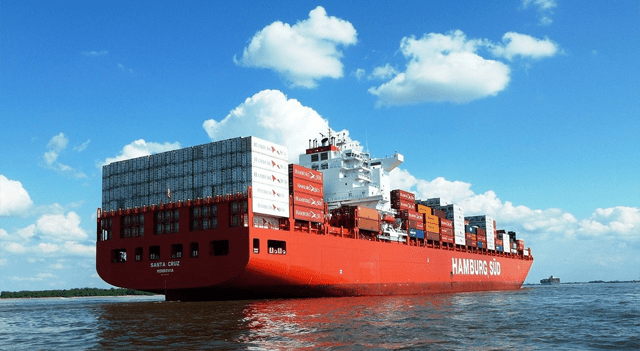
Shares in major container shipping operators, including A.P. Møller Maersk (USOTC:AMKBY) and Hapag Lloyd (USOTC:HPGLY), advanced more than 4% on Monday after Iran-related disruptions in the Strait of Hormuz prompted several carriers to halt vessel transits through the critical waterway.
The developments also supported energy markets, with Brent and U.S. crude futures rising more than 7%, while natural gas prices gained over 4% as of 05:25 ET (10:25 GMT).
Maersk said it had suspended all ship crossings through the Strait of Hormuz until further notice, aligning with similar decisions by Hapag-Lloyd and CMA CGM to reroute services away from the area due to escalating safety risks.
Morgan Stanley urged caution in interpreting the share price reaction as a lasting shift in fundamentals. In a research note, the bank maintained its “underweight” rating on Maersk — the only pure-play container shipping company in its European coverage — arguing that the Hormuz disruption is “meaningful but not ‘Suez scale’” in terms of its impact on global container flows.
“Disruptions at Suez have implications for the global container shipping network, while disruptions to transits at the Strait of Hormuz have implications more on a regional basis,” the analysts said.
The distinction is significant. Prior to the Red Sea crisis, the Suez Canal accounted for roughly 22% of worldwide container traffic.
Transit volumes remain about 90% below levels recorded in the fourth quarter of 2023, despite recent efforts by Maersk and Hapag-Lloyd to gradually reintroduce certain routes through the canal.
Although Gulf ports are sizeable — Dubai’s Jebel Ali handled 15.5 million TEU in 2024, equivalent to around 8% of global container throughput — they do not serve the vital Asia-Europe trade lane that makes the Suez Canal systemically important.
Oil markets, however, face a different dynamic. Around 20% of global petroleum liquids consumption moved through the Strait of Hormuz in 2024, positioning tanker operators as more direct beneficiaries of any prolonged disruption.
For container shipping, Morgan Stanley’s central scenario still points to persistent oversupply and downward pressure on freight rates regardless of how the situation evolves.
If Suez Canal traffic normalises by mid-2026, effective container supply growth is expected to reach 6.2%, compared with demand growth of only 3.3%. Even if the canal remains largely closed, fleet capacity expansion of 3.8% — based on Alphaliner’s February 2026 estimates — would still exceed demand growth.
“Either way, the risk is to the downside on freight rates, notwithstanding short-term dislocations,” Morgan Stanley said.
Maersk shares have recently diverged from broader freight rate trends. Morgan Stanley said it sees “no strong fundamental reason for this to persist,” valuing the stock at 3x FY26 EV/EBITDA and 0.5x price-to-book — both near the lower end of historical valuation ranges.
Copenhagen-listed freight forwarder DSV, rated “overweight” by Morgan Stanley with a price target of DKr 1,635.50, also traded actively as logistics companies moved in line with broader transport-sector gains.