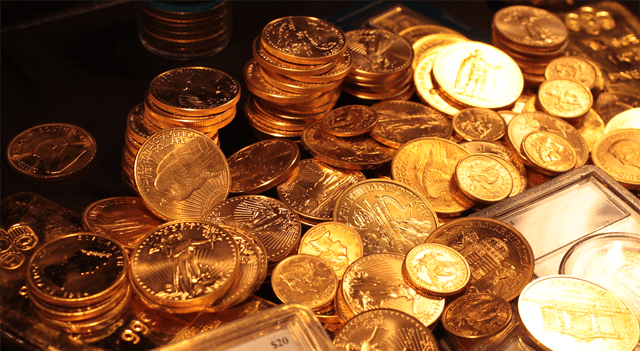
Gold prices moved lower on Monday but recovered from deeper intraday losses as escalating tensions in the conflict involving the U.S., Israel and Iran pushed investors toward the dollar and drove oil prices sharply higher.
Despite the pullback, bullion remained firmly above the $5,000-per-ounce mark as geopolitical uncertainty continued to support demand for traditional safe-haven assets.
By 05:20 ET (09:20 GMT), spot gold was down 1% at $5,117.23 per ounce, while gold futures slipped 0.7% to $5,124.66 per ounce. Earlier in the session, spot prices had dropped as low as $5,015.23 per ounce before rebounding.
Gold holds above $5,000 as Iran conflict fuels safe-haven demand
The precious metal has benefited from increased demand for safe assets since the start of the U.S.-Israel war involving Iran. However, its upward momentum has been limited by concerns that rising inflation linked to the conflict could prompt central banks to adopt a more hawkish policy stance.
Over the past week, the U.S. dollar has outperformed gold, while oil led gains across commodities as fears grew that the war could disrupt global crude supplies.
Both the dollar and oil surged Monday following U.S. and Israeli strikes on Iranian oil facilities, which were viewed as a possible escalation in the conflict. The U.S. dollar index climbed 0.6%, while Brent crude rallied sharply — rising as much as 30% and pushing beyond $100 per barrel.
Oil prices later gave back part of their gains after the Financial Times reported that G7 countries were considering releasing emergency petroleum reserves to offset supply disruptions.
Separately, Bloomberg reported that Saudi producers had begun offering oil on spot markets — an unusual step for the country.
Over the weekend, Iran was also reported to have attacked vessels in the Strait of Hormuz, effectively blocking a key shipping route responsible for roughly 20% of global oil flows.
Gold had already declined by about 2% last week as the metal continued to swing between $5,000 per ounce and the record high near $5,600 reached in late January. Since then, prices have experienced sharp volatility amid heightened speculative trading and growing uncertainty about the path of interest rates.
A much weaker-than-expected U.S. nonfarm payrolls report released Friday briefly fueled hopes that interest rates could fall sooner, although attention has now shifted toward the inflationary risks posed by surging oil prices.
Silver rebounds after dipping below $80
Other precious metals also moved lower Monday, with silver briefly falling below $80 per ounce during early trading.
However, spot silver recovered most of its losses and was trading down 0.6% at $83.8025 per ounce.
Platinum also declined, with spot prices slipping 0.6% to $83.8060 per ounce, although the metal also rebounded from earlier session lows.
Like gold, both silver and platinum have shown significant volatility since the sharp market drop in late January. Nevertheless, their safe-haven appeal and expectations of stronger industrial demand have kept both metals higher so far this year.
Among industrial metals, copper futures fell 0.4% to $12,817.0 per ton.