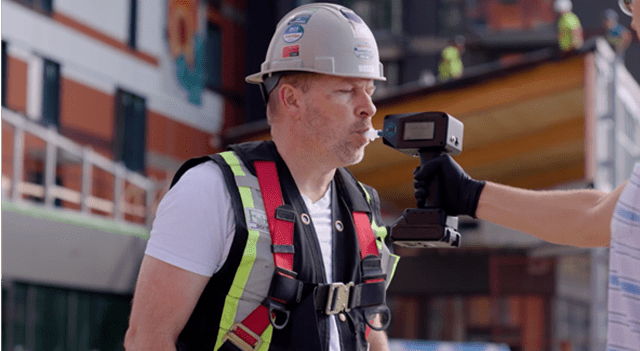
Cannabix Technologies Inc (USOTC:BLOZF) (CSE:BLO) has announced its first commercial delivery of its Marijuana Breath Test (MBT) devices to a major construction firm in the Pacific Northwest, marking a significant step in the company’s push into safety-sensitive industries.
The sale, completed through an authorized reseller, introduces a new approach to cannabis testing in workplaces where safety is paramount. The unnamed client—a large regional contractor involved in industrial, civil, and commercial projects—adopted the MBT system to strengthen its safety protocols and better assess recent cannabis use among employees.
Addressing a Longstanding Industry Gap
Construction remains one of the most injury-prone sectors in the United States, and rising cannabis use has added complexity to workplace safety management. Traditional drug testing methods—such as urine, saliva, and hair analysis—have long been criticized for their inability to distinguish between recent use and past consumption.
These legacy methods can detect cannabis days or even weeks after use, offering little insight into whether an employee is impaired during working hours. This disconnect has created legal and operational challenges, particularly in regions where cannabis use is legal outside of work.
For industries like construction, transportation, and manufacturing—where employees operate heavy machinery or work in high-risk environments—the need for more precise and fair testing methods has become increasingly urgent.
A Breath-Based Solution for Recent Use Detection
Cannabix’s MBT technology aims to solve this problem by focusing specifically on recent cannabis use. The device detects delta-9 THC—the primary psychoactive compound in cannabis—in breath samples within a roughly two- to four-hour window after consumption. This timeframe closely aligns with peak impairment, making the results more relevant for real-time safety decisions.
The system includes a proprietary Breath Collection Unit (BCU) and single-use cartridges that capture and preserve samples for laboratory analysis. These samples are then processed using advanced liquid chromatography-mass spectrometry (LC-MS), a highly accurate testing method.
Cannabix has partnered with Omega Laboratories Inc. to support its laboratory-developed testing (LDT) process. Omega Laboratories brings more than 25 years of experience in forensic toxicology and operates an accredited testing facility.
Balancing Safety and Fairness
According to Cannabix CEO Rav Mlait, the MBT represents a more balanced approach to workplace cannabis policies.
“Safety-sensitive industries are struggling with outdated drug testing methods that do not reflect real-world workplace needs,” Mlait said. “Our Marijuana Breath Test provides a modern, scientifically grounded way to identify recent cannabis use in a fair and non-invasive manner.”
By focusing on recent use rather than historical consumption, the MBT allows employers to enforce safety standards without penalizing workers for legal, off-duty behavior—a growing concern in jurisdictions with legalized cannabis.
Commercialization and Market Potential
This first delivery is a milestone in Cannabix’s broader commercialization strategy. The company expects increasing demand from large employers facing stricter safety regulations, insurance requirements, and workforce management challenges.
Industries with high employee counts and stringent safety standards—particularly construction and industrial sectors—are seen as immediate opportunities. Cannabix is continuing to scale production and expand its reseller network as it positions the MBT as a potential new standard for cannabis detection in the workplace.
A Shift Toward Real-Time Impairment Testing
Scientific research indicates that delta-9 THC remains detectable in breath for a short window that closely corresponds with impairment. This makes breath analysis one of the most practical and relevant tools for determining whether an individual may be under the influence while on the job.
As workplace safety expectations evolve alongside changing cannabis laws, technologies like the MBT could play a critical role in bridging the gap between compliance, fairness, and real-world risk management.