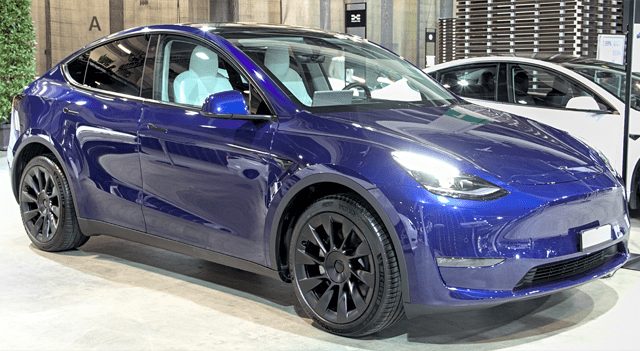
Tesla (NASDAQ:TSLA) appears to be seeing another solid month for vehicle deliveries in Europe, with early registration data showing sharp increases in several markets including France and Denmark.
The electric vehicle maker sold 17,664 units in February, representing 11.8% year-on-year growth, and preliminary figures emerging from March across Europe suggest that sales momentum is continuing. The improvement comes after Tesla lost nearly half of its European market share last year amid rising competition and controversy surrounding the political positions of its CEO, Elon Musk.
Initial figures released today indicate that registrations in France surged 203.1% compared with the same period in 2025, marking the first monthly growth since October. A total of 9,569 vehicles were registered, just shy of the company’s all-time monthly record of 9,572 units set in December 2023.
In Denmark, registrations climbed 144% to 1,447 vehicles, according to data from bilstatistik.dk. Across Scandinavia, Sweden also reported strong growth, with registrations rising 96% to 1,784 units, based on figures from Mobility Sweden.
Additional registration data from Italy, Spain, Norway, Portugal and the Netherlands is expected later in the day.
Deliveries remain central to Tesla’s business
Vehicle deliveries remain the most important metric for Tesla despite growing investor focus on Elon Musk’s push into artificial intelligence, robotaxis and humanoid robotics.
Analysts’ consensus forecasts suggest Tesla will deliver around 365,645 vehicles in the first quarter of 2026. That would represent an increase from the 336,681 units delivered in the same period last year, when production was temporarily disrupted by the Model Y retooling. However, it would still fall short of the 418,227 vehicles delivered in the fourth quarter, implying year-on-year growth of roughly 8–9%.
At the same time, the projected figure would represent a sequential drop of about 12.5–13% from the previous quarter’s total. Such declines are typical for the automotive industry due to seasonal demand patterns, but they have also been amplified by stronger competition and softer demand in key markets including China, the United States and Europe.
A breakdown of delivery forecasts indicates that the Model 3 and Model Y are expected to account for the bulk of shipments, with analysts estimating 351,179 units, highlighting continued consumer preference for the two models.
Long-term growth plans
Looking further ahead, Tesla is projected to deliver 1,689,691 vehicles in 2026, representing 3.3% growth compared with the previous year. The figure forms part of Tesla’s longer-term plan to scale deliveries to 3.032 million vehicles by 2030.
Achieving that target will require significant increases in production capacity, the rollout of additional vehicle models and deeper expansion into new markets.
The company’s first-quarter results for 2026 will therefore be closely watched by investors as a key indicator of whether Tesla can maintain its growth trajectory in an electric vehicle market characterized by intense competition and shifting demand.
Energy business offers diversification
Another potential growth driver lies in Tesla’s diversification beyond vehicles, particularly in energy storage and generation.
With 14.4 GWh of installations in the first quarter of 2026, the company is demonstrating its ability to scale operations in the energy segment. Industry projections suggest annual installations could reach as much as 65.2 GWh, positioning Tesla as both an automotive and energy company and potentially offsetting any slowdown in vehicle sales.
Competitive pressures remain
Despite these opportunities, Tesla faces considerable challenges. Demand in several major markets remains uneven, and competition has intensified, especially from Chinese automakers such as BYD.
Investor caution is reflected in Tesla’s share price, which has fallen roughly 20% since the start of the year. Markets will be closely watching the release of the company’s official delivery figures, scheduled for April 2, 2026, for further clues about the strength of Tesla’s performance.
Analysts remain cautious
Although Tesla’s registrations in Europe improved in February — marking the first annual increase since December 2024 — rival BYD expanded even faster, more than doubling its registrations and approaching Tesla’s 1.8% market share. Automakers Volkswagen and Stellantis also reported gains. Reuters
“I’m seeing a decline,” Morningstar analyst Seth Goldstein told Reuters, referring to Tesla’s major markets and predicting that deliveries could weaken further this year.
For Sam Fiorani of AutoForecast Solutions, recent updates to the Model 3 and Model Y were not substantial enough to lure customers away from newer and cheaper competitors. Reuters
Tesla shifts focus toward new technologies
Tesla has increasingly sought to redirect attention away from delivery figures. In January, the company said production of its Cybercab robotaxi remains on track for this year and announced a $2 billion investment into Musk’s AI startup xAI.
Meanwhile, Tesla’s energy generation and storage division posted record revenue of $3.84 billion in the fourth quarter, representing 25.5% growth.
“Tesla is entering a transition phase,” Investing.com analyst Thomas Monteiro told Reuters, noting that investors are increasingly focused on future product launches rather than quarterly delivery numbers.
Cash burn concerns
If deliveries fall below expectations or if Tesla introduces additional discounts to stimulate demand, investor attention could shift toward the company’s cash usage.
According to Morgan Stanley analyst Adam Jonas, Tesla could burn through more than $8 billion in 2026, Reuters reported. This comes despite the company ending 2025 with $44.06 billion in cash, cash equivalents and investments.
Robotaxi timeline uncertain
The timeline for Tesla’s robotaxi ambitions also remains unclear. In February, Reuters reported that Tesla had not conducted a single test mile with autonomous vehicles in California in 2025 and had not applied for the permits required to operate a commercial driverless ride-hailing service.
By comparison, Waymo, Alphabet’s autonomous vehicle unit, logged more than 13 million test miles before receiving approval to begin charging passengers for fully driverless rides.
Investors watching deliveries closely
For now, investors appear relatively calm as long as Tesla’s vehicle sales remain stable.
Gene Munster of Deepwater Asset Management summarized the current sentiment when he told Reuters: “Zero growth would be a ‘win’ for Tesla.”
However, he cautioned that a sharper decline in deliveries could quickly change the outlook, adding: “that would be a problem.”