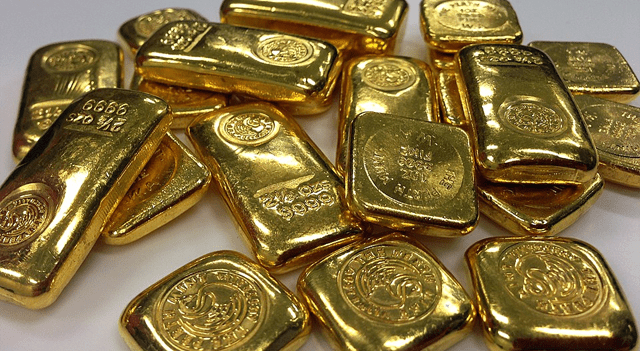
Gold held relatively stable on Monday, trading within a narrow band as the U.S. dollar lacked clear direction. Investors weighed tentative signs of easing tensions between the United States and Iran while looking ahead to a key Federal Reserve policy meeting later in the week.
The precious metal found some support after last week’s sharp decline, with sentiment aided by weekend reports suggesting Iran had put forward a fresh proposal to Washington that includes reopening the Strait of Hormuz.
Spot gold was little changed at $4,711.0 per ounce, while gold futures edged down 0.3% to $4,725.94/oz as of 02:01 ET (06:01 GMT).
Elsewhere in precious metals, price movements were muted. Spot silver remained steady at $75.6975 per ounce, while platinum posted a modest gain of 0.5% to $2,023.54 per ounce.
Uncertainty persists around U.S.-Iran talks
Efforts to restart negotiations between the U.S. and Iran stalled over the weekend after Iranian officials departed Pakistan and Washington scrapped plans to send a delegation to Islamabad.
U.S. President Donald Trump indicated that Tehran could initiate contact if it wished to resume discussions, reiterating that Iran must not obtain nuclear weapons—an issue that continues to underpin the conflict.
However, a report from Axios offered a degree of optimism, indicating that Iran had submitted a new proposal aimed at reopening the Strait of Hormuz and bringing hostilities to an end.
A central element of the proposal involves delaying discussions around Iran’s nuclear programme, a point that may prove contentious for U.S. officials.
Despite this, tensions remained elevated, with a naval blockade still in place and Iran continuing to restrict access through the Strait of Hormuz.
The disruption has driven oil prices higher, fuelling concerns about persistent global inflation and the likelihood of tighter monetary policy. A firmer dollar in this environment has weighed on non-yielding assets such as gold.
Federal Reserve decision in focus
Attention is now firmly on the Federal Reserve’s upcoming policy meeting, where officials are widely expected to keep interest rates unchanged.
Markets will be closely watching the central bank’s economic outlook, particularly given heightened uncertainty linked to the Iran conflict.
This meeting is also expected to be the final one chaired by Jerome Powell, whose term concludes on May 15.
Meanwhile, Kevin Warsh—nominated by Trump as Powell’s successor—told Congress last week that he has not committed to cutting interest rates. He is generally seen as less dovish than many investors had anticipated.
Warsh’s confirmation now appears more likely after Republican Senator Thom Tillis withdrew his opposition, following the Justice Department’s decision to end its investigation into Powell—an inquiry that had drawn criticism for potentially pressuring the Federal Reserve to ease policy.