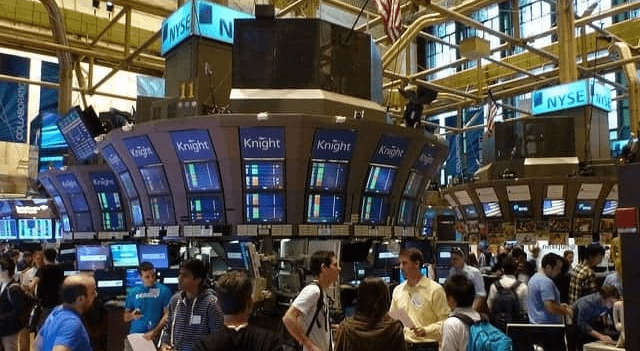
U.S. equity futures moved modestly higher on Thursday as markets continued to react positively to signs that negotiations aimed at ending the conflict between the United States and Iran may be gaining momentum. Meanwhile, oil prices fluctuated around the $100-per-barrel mark, retreating from recent highs but remaining significantly above levels seen before the outbreak of the war.
Futures point to further gains on Wall Street
By 03:39 ET, futures tied to the Dow Jones Industrial Average were up 113 points, or 0.2%. S&P 500 futures gained 15 points, or 0.2%, while Nasdaq 100 futures climbed 77 points, or 0.3%.
The move followed another record-setting session for U.S. equities on Wednesday, driven by reports suggesting Washington and Tehran were edging closer to an agreement that could bring an end to the conflict that has lasted for more than two months.
Technology shares also supported market sentiment after strong earnings and guidance from major semiconductor and AI-related companies. Advanced Micro Devices (NASDAQ:AMD) helped lift chipmakers after indicating that demand tied to artificial intelligence remains robust. Shares in AI server specialist Super Micro Computer (NASDAQ:SMCI) surged more than 24% following upbeat quarterly revenue guidance.
“[S]tocks exploded higher thanks to Iran optimism, another round of strong earnings, and additional fodder for AI bulls,” analysts at Vital Knowledge said.
Reports suggest new U.S.-Iran talks could begin soon
According to the Wall Street Journal, U.S. and Iranian officials have been working through mediators on a one-page framework intended to restart negotiations around a long-term peace agreement. Discussions are reportedly expected to begin next week in Pakistan.
The report said a month-long diplomatic process would then attempt to address disputes surrounding Iran’s nuclear programme and possible sanctions relief, although major differences remain on issues such as uranium enrichment and international inspections.
President Donald Trump said on Wednesday afternoon that the United States had effectively “won” the conflict and described recent talks with Tehran as having been “very good” over the previous 24 hours.
Earlier in the day, Trump wrote on social media that the U.S. military operation against Iran, launched jointly with Israel in late February, would end if Tehran “agrees to give what has been agreed to.” He also warned that military action could resume if negotiations fail.
Iranian officials have issued mixed responses. The country’s foreign minister said Tehran was reviewing the latest U.S. proposal and would communicate its position through Pakistan, which has frequently acted as an intermediary between the two sides. However, separate media reports cited an Iranian official describing the American proposal as little more than a U.S. “wish list.”
CNN reported that Iran was expected to provide its formal response to mediators by Thursday.
Oil remains elevated despite recent pullback
Oil markets remained volatile as traders assessed whether tanker traffic through the Strait of Hormuz could eventually resume after weeks of disruption.
Brent crude futures were last trading down 2% at $99.23 per barrel.
Energy prices have surged since the beginning of the conflict, largely due to the effective closure of the Strait of Hormuz, which handles roughly one-fifth of global oil shipments. Although crude prices have recently eased, they remain well above pre-war levels.
Higher energy costs have pushed U.S. gasoline prices above $4.50 per gallon, levels not seen since the peak of the COVID-19-era energy shock in 2022.
Trump remarked that he had expected oil prices to rise even further, telling reporters he believed crude could have reached “$200, $250.”
He added that even at those levels, the war with Iran would have been “worth it.”
U.S. and China reportedly exploring AI discussions
The Wall Street Journal also reported that Washington and Beijing are considering launching formal discussions focused on artificial intelligence.
The issue could reportedly feature during a planned summit next week in Beijing between President Donald Trump and Chinese President Xi Jinping.
According to the report, discussions would likely centre on risks associated with advanced AI systems, including erratic model behaviour, autonomous military technologies and AI-enabled attacks by non-state actors.
U.S. Treasury Secretary Scott Bessent is expected to lead the American delegation in any talks, although China has yet to appoint its representative.
Shell beats earnings expectations despite lower buybacks
Shell (NYSE:SHEL) reported adjusted first-quarter 2026 earnings of $6.92 billion, surpassing analyst expectations of $6.36 billion and improving from $5.58 billion in the same period last year.
The energy group said stronger trading and optimisation performance across its Downstream and Renewables divisions, improved refining margins, higher realised prices and lower operating expenses contributed to the earnings increase.
Shell also reduced its quarterly share buyback programme to $3 billion, compared with $3.5 billion in the previous quarter.
Adjusted EBITDA rose to $17.7 billion from $15.3 billion a year earlier. Cash flow from operations totalled $6.1 billion, affected by an $11.2 billion working capital outflow linked to inventory and receivable movements caused by commodity price fluctuations.
Advanced Micro Devices stock price