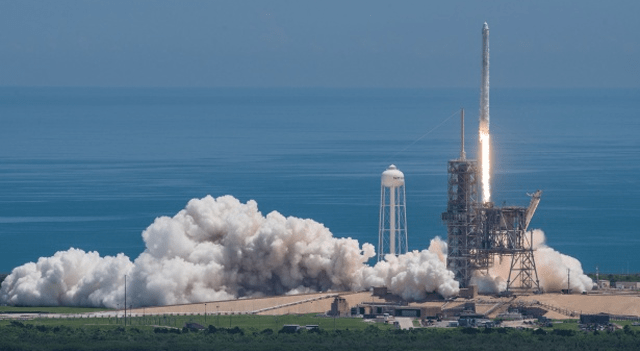
Interest in commercial space investing has surged in recent years, with SpaceX emerging as one of the sector’s most sought-after private companies thanks to its reusable rocket business and rapidly expanding Starlink satellite network.
According to recent SEC filings, SpaceX (NASDAQ:SPCX) is preparing for a potential June IPO at a valuation target of approximately $1.75 trillion, a listing that could become the largest public offering in history.
However, investors looking for exposure to SpaceX do not necessarily need to wait until shares begin trading publicly. Several existing investment vehicles already provide meaningful access to the company.
Ark Venture Fund offers concentrated exposure to SpaceX
One of the most direct routes into SpaceX before its IPO is the Ark Venture Fund, managed by Cathie Wood and ARK Invest.
The fund focuses on acquiring stakes in private companies, with SpaceX currently representing its largest holding.
Since launching in September 2022, the Ark Venture Fund has generated cumulative returns of 151%, equivalent to roughly 30% annualized growth, significantly outperforming the broader S&P 500 over the same period.
Much of that performance came during the past year as valuations climbed sharply for SpaceX, OpenAI and Anthropic, all among the fund’s largest holdings.
The article notes, however, that investing in pre-IPO companies through the Ark Venture Fund comes with drawbacks. As an interval fund, liquidity is limited because investors can only redeem shares during specific windows each quarter.
The fund also carries a relatively high net expense ratio of 2.9%, substantially above fees typically charged by passive ETFs.
Despite those limitations, the Ark Venture Fund remains one of the most concentrated options for gaining exposure to disruptive private AI and technology businesses before they reach public markets.
Baron Partners Fund heavily tied to Musk companies
Another major source of indirect SpaceX exposure is the Baron Partners Fund, managed by billionaire investor Ron Baron.
The fund maintains a concentrated portfolio spanning both public and private companies, with SpaceX accounting for approximately 33% of holdings and Tesla (NASDAQ:TSLA) representing another 20%.
Since its launch in 1992, the Baron Partners Fund has produced annualized returns of 15.6%, outperforming both the S&P 500 and the Russell Midcap Growth Index over the long term.
Although management fees remain higher than those associated with standard ETFs, the fund provides greater liquidity flexibility than the Ark Venture Fund because investors can redeem shares daily at net asset value.
Alphabet stake offers indirect SpaceX ownership
For investors seeking a simpler and more liquid approach, Alphabet (NASDAQ:GOOG) may offer one of the easiest ways to gain indirect exposure to SpaceX.
Google’s parent company invested $1 billion into SpaceX during a 2015 funding round and, according to recent filings, still owns roughly 6.1% of the company.
At a potential $1.75 trillion IPO valuation, Alphabet’s stake could be worth more than $100 billion.
The article suggests that Alphabet could theoretically monetize part of its SpaceX investment after the IPO, potentially redirecting capital toward artificial intelligence initiatives across businesses including Google Search, YouTube, cloud computing, Waymo and custom silicon development.
Unlike private-market investment funds, Alphabet shares trade normally on public exchanges with no special liquidity restrictions or elevated management fees.
The article argues that for growth investors seeking immediate SpaceX-related upside, Alphabet may represent the cleanest and most accessible option available before the anticipated IPO launch.
Want to stay up-to-date on the SpaceX IPO? Find the top asked questions from investors and follow their every move here: https://invest.investorshub.com/spacex-ipo-watch/