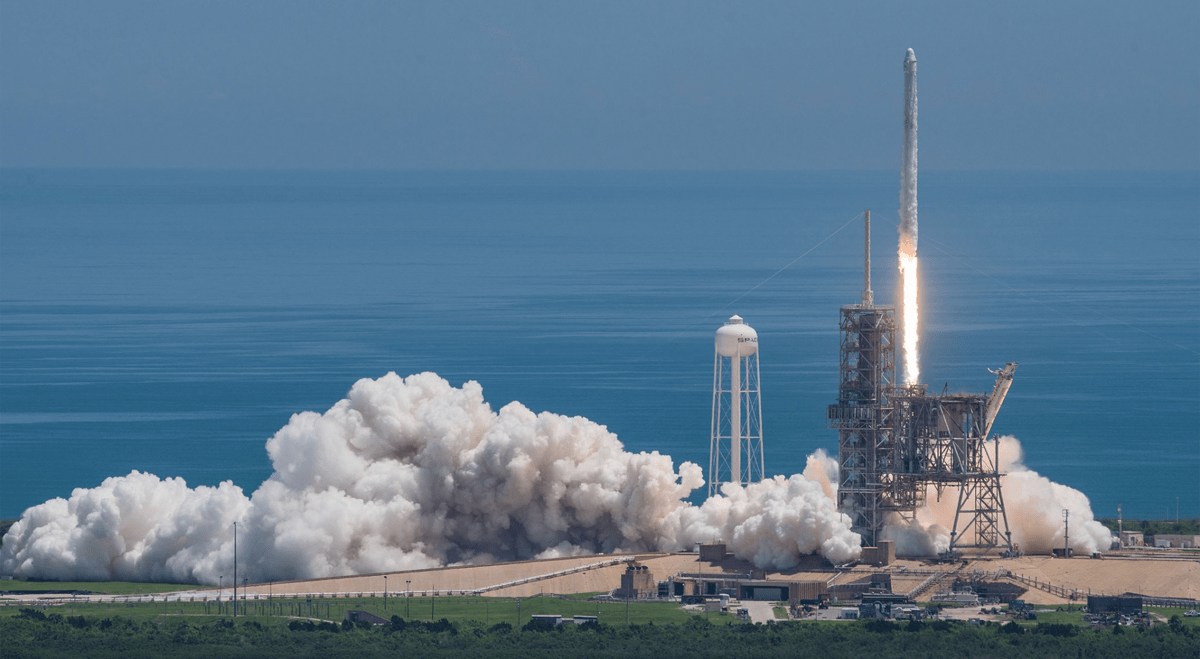
SpaceX (NASDAQ:SPCX) shares gained more than 1% in premarket trading on Monday after Nasdaq confirmed the aerospace and satellite communications company will be added to the Nasdaq 100 index on 7 July.
The inclusion is expected to generate substantial passive investment demand as exchange-traded funds and other index-tracking products adjust their portfolios to reflect the benchmark’s new composition.
SpaceX shares finished Friday up 0.15% at US$153.23, closing just above their IPO opening price. Although the stock initially rallied to an intraday high of US$225.64 following its market debut, it has since surrendered much of those gains. Last week, shares fell 16.4% after KeyBanc adopted a more cautious stance, arguing that the company’s valuation had become increasingly demanding after its post-IPO surge.
With the IPO priced at US$135 per share, investors who participated in the offering remain ahead by roughly 14%. However, those who purchased shares at the market opening price of around US$150 have seen only modest gains.
Analysts Turn Attention to Potential Tesla Combination
Following the completion of the IPO, analysts at Baird believe investor focus may increasingly shift towards the possibility of a merger between Tesla and SpaceX.
“We see the strategic rationale for a merger as clear and compelling with both companies benefitting from greater scale. Questions may arise regarding regulatory review; however, we do not expect significant scrutiny given limited overlap of end markets,” the firm said.
“With regard to the timing of a potential merger (which is admittedly much harder to predict), we foresee a period of waiting as SPCX integrates the recent xAI merger and settles in as a public company more broadly,” the analysts said.
Last week, SpaceX also launched an offering of senior unsecured notes and disclosed cash and cash equivalents of approximately US$100.8 billion as of 19 June. The proceeds will be used to repay bridge financing and for general corporate purposes.
Mixed Analyst Views Despite Strong Long-Term Growth Prospects
KeyBanc initiated coverage with a Sector Weight rating, arguing that SpaceX’s long-term growth opportunities are already largely reflected in its valuation. Across Wall Street, six analysts currently recommend buying the stock, while CFRA remains the only firm with a Sell rating.
KeyBanc described SpaceX as “the dominant leader in space launch and space-adjacent verticals” but said the current risk-reward profile appears balanced until there is greater clarity on the development of the company’s next-generation Starship rocket.
The brokerage estimates the stock trades at roughly 29 times projected 2027 sales and 71 times enterprise value to EBITDA, representing a premium to companies in the space, artificial intelligence and communications sectors.
Starlink Drives Earnings While AI Represents Future Growth
SpaceX now operates across three core divisions. Connectivity, led by the Starlink satellite internet business, generated around 61% of group revenue during 2025. The Space segment includes Falcon 9 and Starship launch operations, while the AI division incorporates Grok and xAI infrastructure following the February 2026 merger with Elon Musk’s artificial intelligence company.
Starlink remains the company’s primary earnings contributor, generating approximately US$11.4 billion in revenue during 2025 with an adjusted EBITDA margin of 63%.
“At sufficient scale, Connectivity alone is capable of supporting a meaningful portion of enterprise value, which we believe limits downside to the overall story and allows the remaining segments (AI, Space) to be valued more as incremental upside rather than required for the thesis to hold,” the analysts wrote.
Although still operating at a loss, the AI division has secured significant long-term computing contracts, including agreements with Anthropic worth approximately US$1.25 billion per month and Google valued at around US$920 million per month.
KeyBanc expects AI revenue to reach roughly US$50.6 billion by 2027, making it the company’s fastest-growing business over the medium term. However, the firm noted that Grok currently holds only a 3.1% share of U.S. enterprise adoption, compared with 41% for Anthropic and 39.5% for OpenAI, describing the next 12 to 24 months as a “prove it phase” for the platform.
The broker also highlighted Starship’s development schedule as a key factor for the investment case. The rocket is expected to play a central role in deploying next-generation Starlink V3 satellites, lowering launch costs through full reusability and eventually supporting orbital data centre infrastructure.
Starship Flight 13 is scheduled for 29 June. While analysts remain optimistic about the programme’s long-term prospects, they noted that “we take a conservative approach on its development timeline.”
SpaceX currently has approximately 13 billion shares outstanding, with only around 5% included in the public float. Elon Musk’s 42% ownership stake remains subject to a lock-up agreement that expires in June 2027.