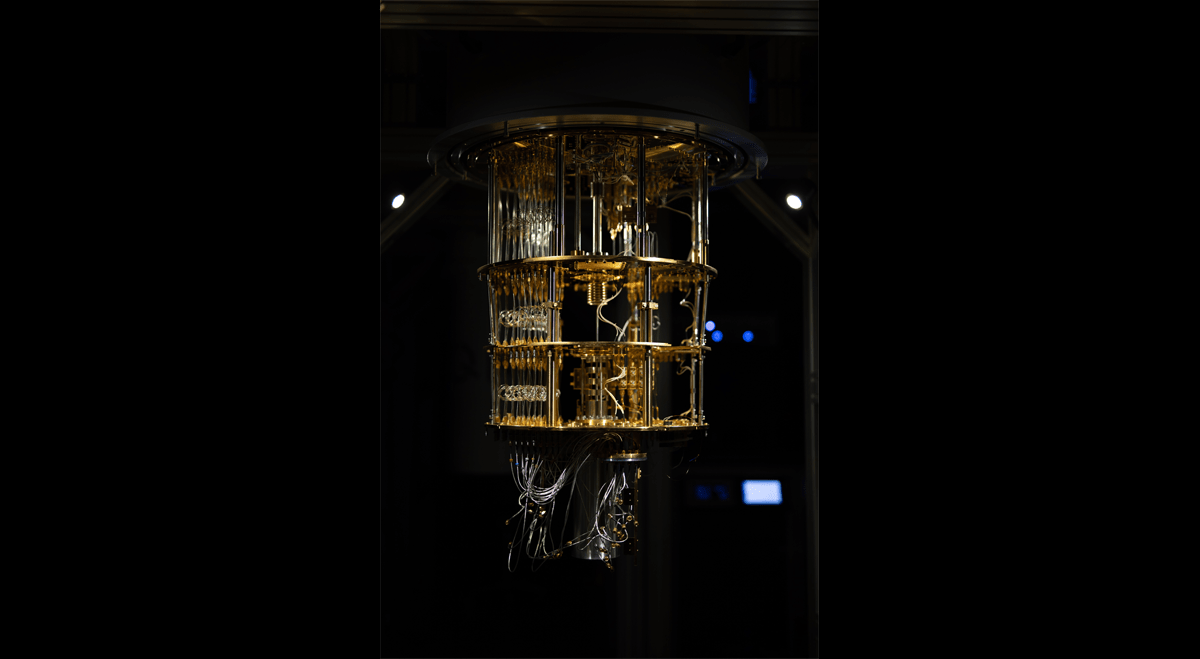
IonQ is presenting nine peer-reviewed papers at IEEE Quantum Week 2026, including four Best Paper Award recipients, with research spanning quantum machine learning, industrial simulation, protein folding, logistics and quantum error reduction.
Key Investor Takeaways
- IonQ (NYSE:IONQ) has nine peer-reviewed papers accepted for QCE26, with four receiving Best Paper Awards.
- Research conducted with Synopsys demonstrated quantum-accelerated graph partitioning that improved end-to-end finite-element simulation time by up to 14.6% across models containing meshes of up to 35 million elements.
- A protein-folding project with Kipu Quantum scaled optimization to 61-qubit instances on IonQ Tempo and reached classical reference energies in four of six sequences.
- Other projects reported up to 12.1% more shipments in a logistics optimization problem and up to 24% lower classification error than the best classical baseline in quantum fine-tuning of foundational AI models.
- The breadth of collaborations across commercial companies, laboratories and universities provides additional evidence of IonQ’s efforts to develop applications beyond quantum hardware itself.
Why IONQ Stock Is in Focus
IonQ’s nine peer-reviewed papers at IEEE Quantum Week put the emphasis on measurable application-level results from its quantum systems rather than solely on hardware specifications.
Four papers received QCE26 Best Paper Awards, covering protein folding, large-scale linear algebra workflows, quantum fine-tuning of foundational AI models and AI-assisted distributed quantum optimization.
One of the more directly measurable industrial projects was conducted with Synopsys. IonQ researchers demonstrated quantum-accelerated graph partitioning that improved end-to-end finite-element simulation time by as much as 14.6% across industrial models with meshes reaching 35 million elements.
In logistics research with Einride, a hybrid quantum-classical optimization workflow identified up to 12.1% more shipments without a meaningful increase in cost using real-world data. The work was scaled to instances of as many as 130 qubits on IonQ Forte and Forte Enterprise.
Meanwhile, research with Kipu Quantum tested protein-folding optimization on IonQ Tempo, scaling to 61-qubit instances and reaching classical reference energies for four of six protein sequences through a hybrid quantum-classical approach.
Why This Matters for Investors
For investors evaluating commercial quantum computing, the significance of the research lies in its focus on practical workloads and comparisons with classical approaches.
The Synopsys work, for example, links quantum processing to the overall execution time of an industrial finite-element workflow rather than evaluating an isolated quantum algorithm. That may provide a more relevant framework for assessing whether quantum technology can eventually produce useful performance improvements within existing computational processes.
The foundational AI research provides another comparison. Working with QuantumBasel and the University of Basel, researchers reported classification error as much as 24% below the best classical baseline and identified a measurable energy-to-solution break-even point at around 34 qubits.
Other papers broaden the potential application set. IonQ researchers used quantum neural networks for missing clinical-data reconstruction, tested quantum approaches to three-dimensional transport problems and used mid-circuit measurements on IonQ Tempo to reduce errors in computational chemistry simulations.
These remain research results rather than evidence of commercial revenue or widespread deployment. However, the combination of peer review, external collaborators and quantitative comparisons may give investors additional benchmarks for tracking progress in IonQ’s application strategy.
What to Watch Next
The next question is whether results demonstrated through these research projects progress into larger workloads, repeatable customer applications or commercial deployments.
Investors may also watch the development of IonQ’s collaborations with organizations such as Synopsys, Einride and Kipu Quantum, particularly where the research has already produced measurable performance or optimization results.
Further scaling of workloads on Tempo, Forte and Forte Enterprise, alongside evidence that quantum-assisted approaches can maintain advantages as problem sizes increase, could provide additional indicators of progress toward practical quantum computing.