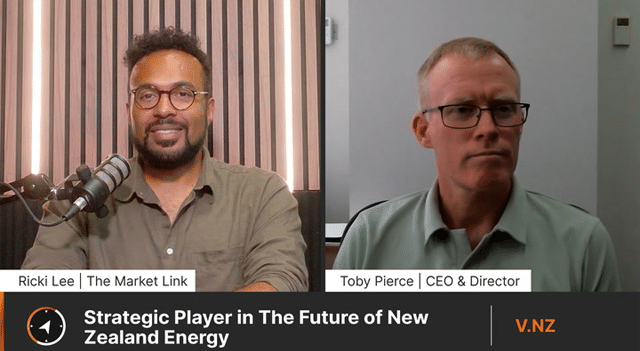
New Zealand Energy CEO Toby Pierce discusses the company’s Taranaki production portfolio, Tariki gas storage project and upcoming growth milestones.
Ricki:
What happens when a depleted gas field gets a second life — not just as a source of energy, but as infrastructure designed to help secure an entire country’s energy supply?
Today we’re looking at New Zealand Energy Corp., an established producer with a portfolio of producing assets, infrastructure and development opportunities in New Zealand’s Taranaki Basin including its flagship Tariki project. New Zealand has a particularly interesting energy market: domestic gas production is declining, there are currently no gas imports, and periods of tight supply have pushed spot prices significantly higher.
This article is disseminated in partnership with New Zealand Energy Corp. It is intended to inform investors and should not be taken as a recommendation or financial advice.
For New Zealand Energy, that backdrop creates opportunity across the business: increasing production from its existing assets, bringing additional wells and reserves online, leveraging its infrastructure position, and advancing Tariki — first as a source of gas production and, longer term, as a potential underground gas-storage facility.
Joining me to discuss New Zealand Energy’s broader portfolio, Tariki and the milestones ahead is Toby Pierce, CEO and Director of New Zealand Energy Corp.
Toby:
Thanks, Ricki. Happy to be here.
Ricki:
It’s a pleasure to have you with us. So Toby, before we look at the individual assets, can you set the scene for us? What makes New Zealand’s gas market so unusual, and why does this combination of declining domestic supply and no current import infrastructure create an opportunity for New Zealand Energy?
Toby:
Yes, high prices overall in the gas markets create a significant opportunity for ourselves and any player that has gas assets in New Zealand. Historically, Maui, a great big offshore field, produced substantial amounts of gas at low prices for New Zealand. A large industry was built up around that, and now that the Maui field is at the end of its life, there is a big gap between supply and available resources.
Ricki:
And New Zealand Energy already has producing assets in Taranaki and has been working to increase production from opportunities including Ngaere and Copper Moki. Can you walk us through the existing portfolio, where production stands today, and where you see the most immediate opportunities to grow production and cash flow?
Toby:
Absolutely. So outside of our Tariki gas storage project, we have two assets. one is oil, production at Ngaere in Waihapa, and second is the Tariki gas production. So overall, we have about 500 BOE per day of gross production across the portfolio. We believe we have access to additional resources and reserves and can bring those on in a tidy fashion.
Ricki:
And you also have an established infrastructure position through the Waihapa Production Station. How important is owning infrastructure in a mature producing basin like Taranaki, both for your existing operations and as you look at future development opportunities?
Toby:
it’s very important, Ricki. it allows us to bring production on very quickly. It allows us to an area that is fairly highly populated, it allows us to tie things in, across our portfolio. It also allows us to help other people, assist other people, for a fee of course, bring their production online as well, which overall enhances our economics.
Ricki:
Let’s turn to Tariki. You’ve already restarted the Tariki-1A and Tariki-5A wells this year, and you’re now working toward continuous production. What have those initial production tests told you about the field, and what needs to happen to establish Tariki as a meaningful source of gas production?
Toby:
The great thing about the data we received was the pressures dropped a lot less, which signifies that the resources may be a lot larger, for recoverable gas. Going forward, we plan to bring Tariki-5A back online. We have the equipment now that will allow us to do that. In addition, both Tariki-1A and Tariki-5A gas production should trend higher towards our maximum, facility capacity for approximately six million cubic feet per day.
Ricki:
But the bigger vision for Tariki goes beyond simply producing the remaining gas. You’re looking to convert the depleted field into an underground storage facility with a targeted working capacity of around 15 to 30 billion cubic feet. Why is Tariki particularly well suited to gas storage, and how important could a facility of that scale become to New Zealand’s energy system?
Toby:
It could be a very important piece of the puzzle in that it is right at the heart of the backbone of all infrastructure. It’s an extremely good reservoir that you can both inject and produce gas out of. Remember, it’s produced over fifty-two BCF over the life of its over the life of the field. It’s also of a size that would meet New Zealand’s domestic needs for approximately a year. So in times of very dry weather where the dams aren’t filling or the wind isn’t blowing, the gas backbone that the gas storage business could deliver would be significant.
Ricki:
You’ve already completed much of the geological and regulatory work, and the project is now moving through front-end engineering and discussions around customer capacity. What still needs to fall into place before you can make a final investment decision, and how are those commercial discussions progressing?
Toby:
The discussions are progressing well it’s no secret we’re in discussions with a group called Genesis Energy. we signed an MOU back in November of last year. Those discussions are ongoing. we are confident that we’ll reach a conclusion to that activity here shortly. And that’s the key piece to the FID decision, making sure we have an off-taker to move forward with.
Ricki:
And finally, Toby, when investors look at New Zealand Energy over the next twelve to eighteen months, there are really two stories developing in parallel, growing the underlying production business and advancing the larger Tariki opportunity. What are the key milestones investors should be watching across the entire company, and what could successful execution of that strategy ultimately mean for New Zealand Energy?
Toby:
Beyond the Tariki gas storage business and, and the decision to reach FID, we have a whole host of upcoming, well interventions and workovers. And those individual workovers, while relatively small, will add up to potentially a thousand barrels of oil equivalent per day in production across the portfolio. And that will take place over the next three to six months. They’re fairly heavily weighted in calendar quarter one of next year. And we see lots of activity, and we’re excited to get going finally after, a period of work to get our infrastructure, up to speed with the various volumes that it may need to take.
Ricki:
Well, Toby, thank you again for joining us today and giving us a closer look at New Zealand Energy’s investment opportunity.
Toby:
Thanks, Ricki. Appreciate it.
Ricki:
For more information, you can visit newzealandenergy.com. I’m Ricki Lee, and this has been The Capital Compass. Thanks for watching. We’ll see you again next time.
Sponsored Article: InvestorsHub.com Inc. dba The Market Link has been compensated CASH: $1,053 by New Zealand Energy Corp. (TSXV:NZ) for the publication and distribution of this content. This is not independent editorial content. For full compensation disclosure visit investorshub.advfn.com/boards/disclaimer.aspx